What Is UTTO Oil & Does Your Tractor Need It?
A tractor does not run on engine oil alone. Behind the engine, one hard-working fluid usually lubricates the transmission, the hydraulics and the brakes all at once — and that fluid is UTTO. If you have ever heard a tractor’s wet brakes chatter or felt the hydraulics fade, the UTTO is often the reason.
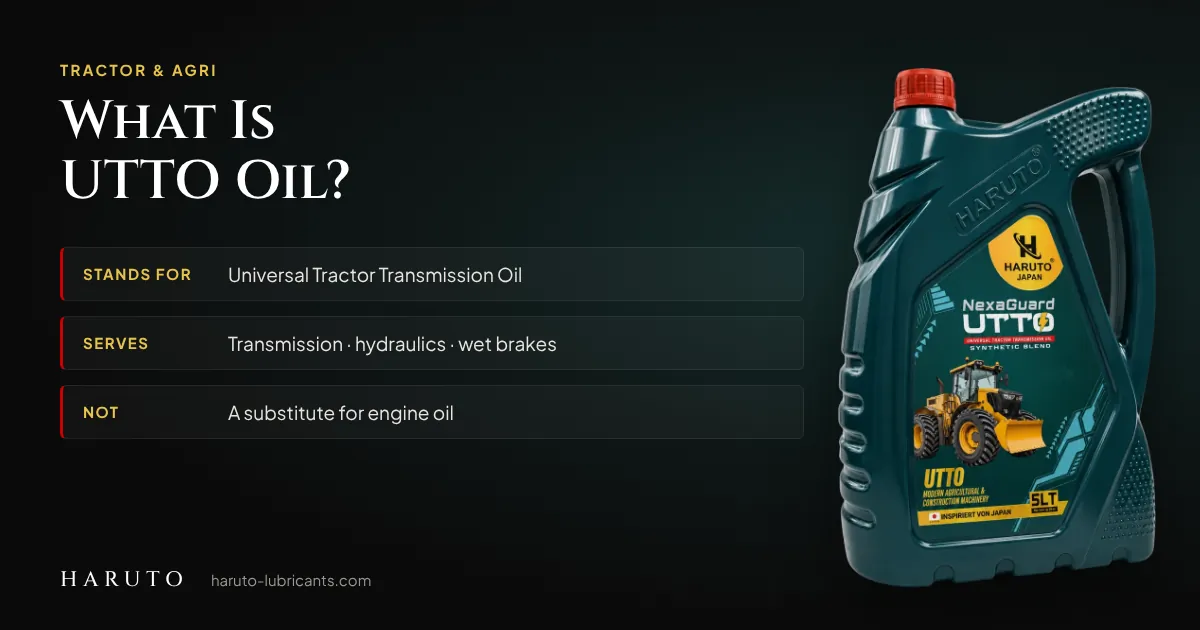
What UTTO stands for
UTTO = Universal Tractor Transmission Oil. It is a single multi-purpose oil engineered to lubricate several systems on a tractor at the same time:
- The transmission and final drives
- The hydraulic system (loader, three-point linkage, steering)
- The wet (oil-immersed) brakes and, on many tractors, the PTO clutch
Because one sump often feeds all of these, the oil has to protect gears, run the hydraulics, and stop the brakes squawking — all without foaming or losing its friction properties.
Why you cannot just use engine oil
Engine oil is designed for a very different job — combustion, soot and high temperatures — and lacks the specific friction and anti-wear additives a wet-brake, hydraulic-transmission system needs. Using engine oil in the transmission can cause brake chatter, hydraulic wear and poor shifting. Keep engine oil in the engine and UTTO in the transmission.
UTTO vs STOU vs engine oil
| Oil | What it lubricates |
|---|---|
| Engine oil | The engine only |
| UTTO | Transmission, hydraulics and wet brakes (not the engine) |
| STOU | Super Tractor Oil Universal — engine and transmission/hydraulics in one oil |
STOU is a genuine one-oil convenience for some machines, but many modern tractors are designed around a dedicated engine oil plus a dedicated UTTO. Follow the maker’s recommendation.
UTTO vs gear oil vs hydraulic oil
Most workshops keep gear oil and hydraulic oil on the shelf, and it is tempting to top up a tractor transmission with whichever is nearest. Neither is a substitute.
| Oil | What it is built for | Why it falls short in a UTTO system |
|---|---|---|
| Automotive gear oil (for example EP-90, GL-5) | Heavy extreme-pressure protection for hypoid axles | Too thick for the hydraulics when cold, and its EP chemistry is not balanced for wet-brake and wet-clutch friction materials — expect noise and sluggish hydraulics |
| Anti-wear hydraulic oil (AW 32, 46, 68) | Clean, stable fluid for pumps and valves | Lacks the extreme-pressure protection the gears need and the friction balance the brakes need |
| UTTO | Gears, hydraulics and wet brakes from one sump | The correct choice wherever the manual specifies it |
The logic works the other way too: UTTO does not replace gear oil in a separate axle housing or hydraulic oil in an excavator. Use each product where its compartment calls for it — our GL-4 vs GL-5 gear oil guide and hydraulic oil guide cover those systems.
Diagnosing wet-brake chatter, noise and weak hydraulics
The transmission oil sits behind many complaints that get blamed on worn parts. Before replacing brake discs or a hydraulic pump, look at the oil.
| Symptom | Likely oil-related cause | What to check |
|---|---|---|
| Brakes chatter, squeal or squawk when applied | Wrong fluid, worn-out friction additives, or engine oil mixed in | Service history and the last top-up; drain and refill with the specified UTTO |
| Brakes grab or pull to one side | Contaminated or glazed friction surfaces | Oil condition and brake adjustment; discs may need inspection |
| Weak or fading brakes | Low level, water in the oil, overheated fluid | Level with implements lowered; milky appearance. Weak brakes are a safety issue — do not work the tractor until the brakes have been checked |
| Hydraulic lift slow, jerky or drops under load | Low level, foaming oil, blocked suction strainer or filter, water | Level, foam on the dipstick, strainer and filter condition |
| Transmission whine or hard shifting | Low level, wrong viscosity, oil past its life | Level, hours on the oil, correct product |
| Milky or creamy oil | Water ingress | Breathers, seals and washing practice — change the oil |
After a fluid-related brake problem, one drain and refill may not clear it, because some old oil stays in coolers, lines and cylinders. A second change after a short spell of work is common practice. If the noise continues on fresh, correct oil, the friction discs may be glazed or worn and need mechanical attention.
Choosing the right UTTO
Match the UTTO to the specification in your tractor handbook (many call for a specific OEM or industry spec). Haruto’s NexaGuard UTTO is formulated for the transmission, hydraulics and wet brakes of modern tractors working in Indian conditions.
Change intervals and what shortens them
UTTO change intervals are set by the tractor maker in engine hours and are usually longer than engine-oil intervals, because the transmission does not see combustion soot. Longer is not the same as never: over time the oil oxidises, its friction additives deplete, and it collects wear metal, water and dirt.
Work to the shorter end of the manual’s range when the tractor:
- does heavy loader or hydraulic work, which keeps the oil hot and cycles it hard;
- puddles paddy or works deep wet fields, where water can get in around seals and breathers;
- runs implements whose hydraulic cylinders share the tractor’s oil;
- has needed frequent top-ups, which points to leaks — and to unknown oils going in.
Change the hydraulic filter and clean the suction strainer and magnetic drain plugs at every UTTO change. What you find on the strainer is a free report on what is happening inside.
Contamination: water, dirt and the wrong oil
Water
Water is the most common UTTO contaminant in India. It gets in from pressure-washing straight at seals and breathers, from working in flooded fields, and from condensation in a tractor parked through the monsoon. Transmissions run cooler than engines, so water tends to stay in the oil rather than evaporate. Wet oil turns milky, loses its rust protection, foams in the hydraulics and upsets wet-brake friction. If the oil looks milky, change it.
Dirt
Dust enters through the filler cap, the breathers and, above all, the implement hydraulic couplers. Wipe couplers before connecting, keep the dust caps on, and make sure implements are not sending dirty or different oil back into the tractor’s sump.
The wrong oil
Engine oil poured into the transmission by mistake, or an unknown loose oil used for a top-up, upsets the friction and anti-wear balance. A small amount may only cause noise; a larger amount calls for a full drain and refill. Keep transmission oil in its own labelled container and note every top-up.
Checking and changing UTTO correctly
Checking the level
- Park on level ground with the engine stopped.
- Lower the three-point linkage, loader and any hydraulic implement fully, so oil returns from the cylinders to the sump. A raised loader makes the level read low and invites an overfill.
- Read the sight glass or dipstick in the condition the manual specifies — some tractors are checked cold, some warm.
- Top up only to the mark. Overfilling can cause foaming and leaks from the breathers.
Changing the oil
- Work the tractor until the oil is warm and contaminants are in suspension, then lower all implements.
- Remove every drain plug the manual lists — transmission, hydraulic housing and, on some tractors, the final drives.
- Inspect and clean the magnetic plugs and suction strainer; replace the hydraulic filter.
- Refit the plugs and refill with the specified UTTO. Check the capacity in the manual — on most tractors it is far larger than the engine sump.
- Start the engine, cycle the linkage, steering and brakes, lower everything and recheck the level.
Planning and storing UTTO for a farm or contractor fleet
Transmission oil is bought in larger quantities than most owners expect, and it often sits badly stored between changes. A little planning avoids running short in the middle of the season and topping up from a dirty, half-empty drum.
Worked example: how much to keep
Suppose a custom-hiring operator runs four tractors, and each handbook lists a transmission and hydraulic capacity of about 40 litres. Capacities vary widely between models, so always work from the figure in your own manual.
- One full change for all four tractors needs about 160 litres.
- Add an allowance for top-ups, and a larger one if implements with their own cylinders are connected and disconnected often.
- A 210 L drum covers one round of changes and leaves about 50 litres for top-ups until the next round.
- A farmer with one such tractor is better served by two 26 L packs: one change with about 12 litres to spare, used up before the pack sits open for months.
Storing it so it stays clean
- Keep drums and pails under cover and off the ground. A drum that has to stand outdoors is best laid on its side with both bungs level, so rainwater cannot pool over them and be drawn in as the drum breathes through hot days and cool nights.
- Wipe the top of the drum before opening it. Dust and water lying round the bung go in with the first pump stroke.
- Keep a hand pump, funnel and jug for UTTO only. A funnel last used for engine oil or diesel carries that contamination straight into the transmission.
- Close bungs and lids tightly after every use and write the opening date on the pack.
- Use the oldest stock first, and finish an opened drum before opening the next.
UTTO checklist and questions for your supplier
| When | Task |
|---|---|
| Daily | Look for leaks under the transmission and along hydraulic lines; listen for brake noise |
| Weekly in season | Level check with implements lowered; wipe couplers and check dust caps |
| After washing or wet work | Check for milky oil |
| At the manual’s interval | Drain and refill, change the filter, clean strainer and magnetic plugs; record hours and litres |
| After any brake or hydraulic complaint | Check level and oil condition before replacing parts |
When buying, ask the supplier:
- Which tractor transmission specifications does the product meet, as stated on its data sheet — and does that match your handbook?
- Is it formulated for wet brakes and wet PTO clutches?
- What is its viscosity, and does it suit your hydraulics in both summer and winter?
- Which pack sizes are available for your transmission capacity and number of tractors?
Haruto NexaGuard ATF and TQ fluids come in 500 ml, 1 L, 7.5 L, 10 L, 20 L, 26 L, 50 L and 210 L packs — see the ATF and transmission range.