GL-4 vs GL-5 Gear Oil: What's the Difference?
GL-4 and GL-5 are the two API gear-oil service ratings you will see most often, and they are frequently — and wrongly — treated as interchangeable. The difference is the level of extreme-pressure (EP) additive, and getting it wrong can either leave gears unprotected or quietly corrode your gearbox synchronisers. Here is what each rating means and how to choose.
What the GL ratings mean
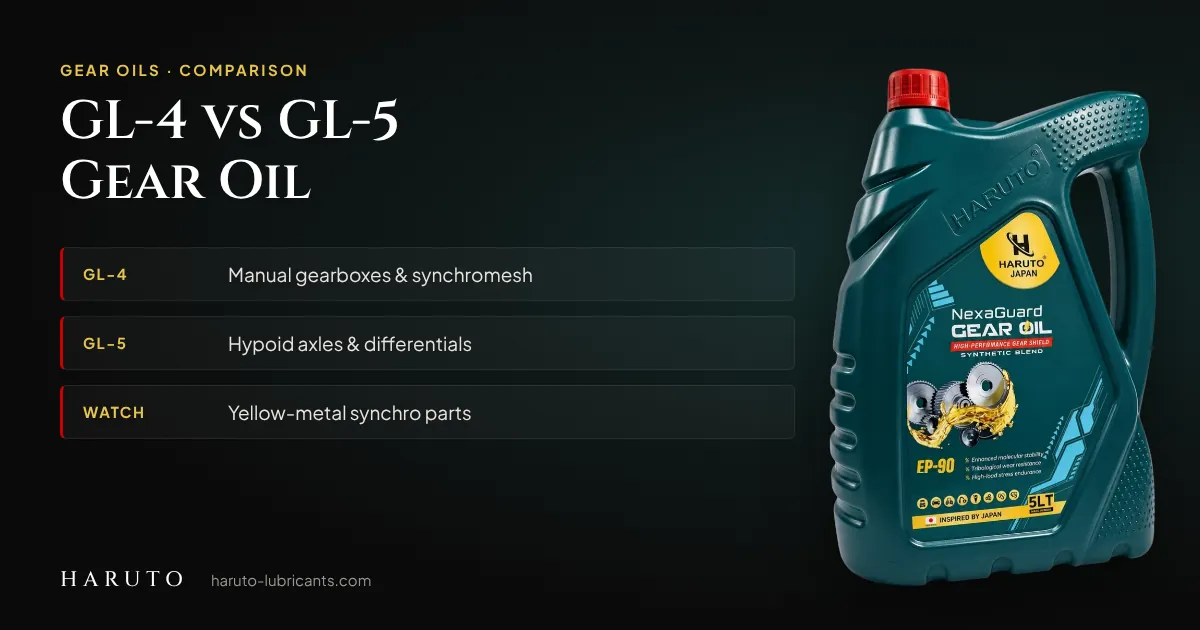
API GL ratings describe the load-carrying and EP performance of an automotive gear oil. GL-4 and GL-5 use the same base test but differ in additive concentration: GL-5 carries roughly double the EP additive of GL-4, for higher-load applications like hypoid differentials.
GL-4 — for manual gearboxes and synchros
GL-4 oils have a moderate EP additive level suited to manual transmissions, transaxles and synchromesh gearboxes. The lower active-sulphur content is gentler on the 'yellow metals' (brass and bronze) used in synchroniser rings, which is why most manual gearboxes specify GL-4.
GL-5 — for hypoid axles and differentials
GL-5 oils carry a higher EP additive dose for the intense sliding loads in hypoid final drives, differentials and heavy axles. That protection comes from more active sulphur-phosphorus chemistry, which can be corrosive to yellow metals if used where it is not required.
Viscosity grade is a separate question: 80W-90, 85W-140, EP-90 and EP-140
The GL rating tells you about additive chemistry. Thickness is set by a different standard, SAE J306, which grades automotive gear oils by their viscosity at 100 °C and, for the "W" grades, by how they behave in the cold. Gear-oil numbers run on their own scale: an SAE 90 gear oil is roughly as thick as an SAE 40 to 50 engine oil.
| Grade | Viscosity at 100 °C (SAE J306) | Where you typically see it |
|---|---|---|
| 75W-90 | 13.5 to under 18.5 cSt, with very good cold flow | Many modern manual gearboxes |
| 80W-90 | 13.5 to under 18.5 cSt | Everyday axles, differentials and gearboxes |
| 85W-140 | 24.0 to under 32.5 cSt | Heavy truck and tipper axles, hot running |
| EP-90 / EP-140 | Trade names for SAE 90 / 140 oils with EP additive | Indian shorthand on drums and orders |
"EP-90" and "EP-140" tell you the viscosity class and that the oil carries extreme-pressure additive — not whether that additive level is GL-4 or GL-5. Read the GL rating on the label alongside the grade, and use the viscosity the manual specifies. Thicker is not automatically safer: an 85W-140 in a gearbox designed for 80W-90 makes cold shifts stiff and costs fuel.
The yellow-metal / synchro issue
This is the heart of the matter. Using a GL-5 oil in a gearbox that specifies GL-4 can, over time, attack brass and bronze synchroniser components, leading to harder shifting and wear. Conversely, using GL-4 in a hypoid differential that needs GL-5 leaves the gears under-protected against scoring. Always follow the equipment maker's specification.
How EP additives work — and why they attack yellow metals
In a hypoid differential the pinion slides across the crown wheel under very high pressure, the oil film becomes extremely thin and local temperature spikes. EP additives — mostly sulphur- and phosphorus-based compounds — are designed to stay quiet at normal temperature and react with the steel surface only when that flash heat appears. The reaction forms a thin layer that shears away instead of the teeth welding and tearing.
That same reactivity is the problem. Copper alloys such as brass and bronze react with active sulphur at much lower temperatures than steel does. In a synchromesh gearbox this shows up as:
- Synchroniser rings that darken and lose the edges of their friction grooves, so they grip less well.
- Crunchy shifts, especially on a cold morning or when changing quickly.
- Faster damage in heat — an overloaded LCV in summer traffic shows symptoms sooner.
Limited-slip differentials need friction modifiers
A clutch-type limited-slip differential (LSD) uses friction plates to send torque to the wheel that has grip. Those plates need an oil with the right friction modifier, usually sold with "LS" in its name, or a separate modifier added as the maker specifies. Without it, an LSD often chatters or shudders on tight, slow turns. The manual will say whether an LS-type oil or an additive is required.
GL-4 vs GL-5 at a glance
| Property | GL-4 | GL-5 |
|---|---|---|
| EP additive level | Moderate | High (≈2× GL-4) |
| Yellow-metal safe | Generally yes | Not always |
| Typical use | Manual gearboxes, synchros | Hypoid axles, differentials |
| Load capacity | High | Very high |
| Use interchangeably? | No — follow OEM spec | No — follow OEM spec |
So can you use GL-5 instead of GL-4?
Not by default. If the gearbox calls for GL-4, use GL-4 (or a verified yellow-metal-safe GL-4/GL-5 dual-rated oil). If the axle calls for GL-5, use GL-5. The grade (for example EP-90 or EP-140) sets the viscosity; the GL rating sets the additive chemistry — match both to the specification.
Signs the gear oil is wrong — or worn out
Gear-oil problems build up as noise, heat and a change in shift feel. Use this as a first check:
| Symptom | Likely cause | What to check |
|---|---|---|
| Notchy or crunchy shifts, worse when cold | Oil too thick for the gearbox, or synchros worn by the wrong GL rating | Grade and GL rating against the manual |
| Whine that rises and falls with load | Low oil level, worn teeth or bearings | Level at the fill plug; metal on the drain magnet |
| Housing much hotter than usual | Low level, wrong viscosity, overloading, blocked breather | Level, grade, breather |
| Chatter or shudder on tight turns | Limited-slip differential without the right friction modifier | Whether the axle is an LSD and what oil is in it |
| Milky or cloudy oil | Water from river crossings, flooding or pressure washing | Drain and refill; inspect seals and breather |
| Flakes or chips on the drain magnet (fine grey paste is normal) | Pitting or spalling on gear teeth or bearings | Inspect gears and bearings before refilling |
Checking, topping up and changing gear oil
How to check and top up a differential or manual gearbox
- Park on level ground and clean around the fill (check) plug, usually on the side of the housing.
- Always loosen the fill plug before the drain plug. If the fill plug turns out to be seized after you have drained the oil, the vehicle cannot be driven.
- In most axles and gearboxes the correct level is the lower edge of the fill hole; the manual decides.
- Top up with a hand pump until oil just begins to run out, then refit the plug with a new washer if one is used.
- Check the axle breather is clear; a blocked one pushes oil past the seals.
Change intervals and contamination
Gear oil outlasts engine oil, but the EP additive is used up and the oil oxidises with heat. Drain intervals are set by the vehicle or axle maker — typically in kilometres for road vehicles and hours for off-highway machines. Shorten them for severe service, which in India is the norm: overloaded tippers, stop-start city buses, ghat roads and summer heat.
Water is the other enemy. A hot axle driven through a flooded road or a river crossing cools suddenly, and the housing draws water in through the breather and seals. Pressure washing close to axle seals does the same. If you find milky oil, change it promptly rather than at the next service, and after a monsoon of waterlogged roads, check fleet vehicles.
Industrial gearboxes are a different job
GL-4 and GL-5 apply to automotive gear oils. Enclosed industrial gearboxes on conveyors, crushers and mixers use industrial EP gear oils, graded by ISO viscosity at 40 °C (typically ISO VG 220 to 680) and specified against industrial standards such as DIN 51517-3 (CLP). The two families should not be swapped:
- Different scales. ISO VG is measured at 40 °C and SAE J306 at 100 °C, so the numbers cannot be compared.
- Long life in large sumps. Industrial oils are built for oxidation life, water separation and foam control; an automotive gear oil can hold water and foam in a big gearbox.
- Bronze worm wheels. A highly active automotive EP oil can attack the bronze wheel of a worm drive.
- Axle loads. Industrial oils are not designed for the sliding loads of a hypoid axle.
Plants that also run trucks or loaders should keep the two in separate, clearly labelled stock.
Quick decision table
A starting point — confirm against the manual or the gearbox plate.
| Application | Typical rating | Typical grade | Watch out for |
|---|---|---|---|
| Manual gearbox with synchros (cars, pickups, LCVs) | GL-4, or a dedicated manual-transmission fluid | 75W-90 or 80W-90, as specified | No GL-5 unless verified dual-rated |
| Hypoid rear axle, trucks and buses | GL-5 | 80W-90 / EP-90; 85W-140 / EP-140 for heavy, hot duty | Scoring if GL-4 is used |
| Limited-slip differential | GL-5 with LS friction modifier | As specified | Chatter on turns without LS |
| Tractor transmission with wet brakes | UTTO / tractor transmission fluid, unless gear oil is specified | As specified | Gear oil can upset brake and clutch friction |
| Enclosed industrial gearbox | Industrial EP (CLP) | ISO VG 220–320 | Do not use automotive gear oil |
| Slow, heavily loaded reducer or worm drive | Industrial EP, or as the maker specifies | ISO VG 460–680 | Bronze worm wheels need a compatible oil |
Haruto NexaGuard gear oils cover automotive EP-90 and EP-140 grades and industrial EP grades from ISO VG 220 to 680, in packs from 500 ml to 210 L. For a manual gearbox, ask for the data sheet and confirm the oil suits what your handbook specifies before you fill. See the Haruto gear oil range, and for tractors read what UTTO oil is.