Best Engine Oil for Your Tractor in India (2026 Guide)
The right engine oil is one of the cheapest ways to protect an expensive tractor — the wrong one costs you in wear, fuel and downtime. In India, choosing the best tractor engine oil comes down to three things: the viscosity grade, the API performance rating, and matching both to your tractor and working conditions. Here is a practical guide.
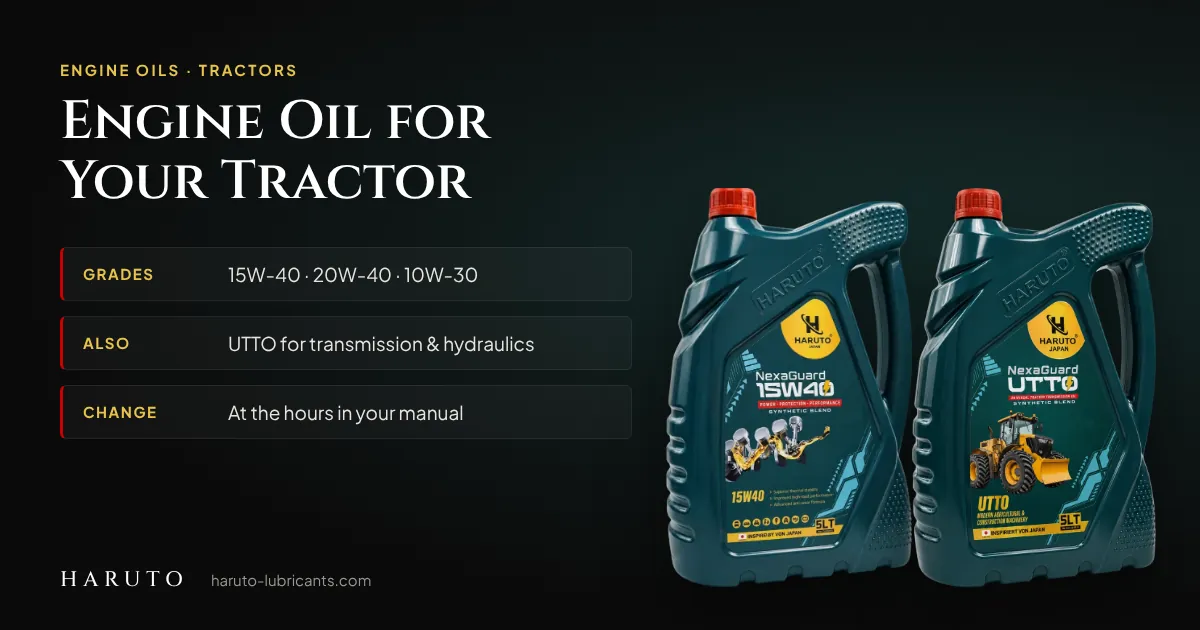
Common tractor engine oil grades in India
Most tractor diesel engines in India run on one of three multigrade oils:
| Grade | Best for |
|---|---|
| 15W-40 | The all-round favourite — works across most Indian climates and modern tractors |
| 20W-40 | Slightly thicker; suits older engines and consistently hot regions |
| 10W-30 | Better cold-start flow for colder northern regions and some newer engines |
When in doubt, 15W-40 is the safest general choice for Indian conditions — but always follow the grade in your tractor’s manual.
API rating matters as much as viscosity
Viscosity (the 15W-40 part) is only half the story. The API rating tells you the oil’s detergency, wear protection and how modern it is. For today’s tractors, look for API CH-4 or CI-4 (or higher) diesel ratings — they keep the engine clean, resist soot and protect against wear under load. A correct-viscosity oil with an outdated API rating is a false economy.
Don’t forget transmission & hydraulic oil (UTTO)
A tractor needs more than engine oil. The transmission, hydraulics and wet (oil-immersed) brakes usually run on a single UTTO — Universal Tractor Transmission Oil. The correct UTTO prevents brake chatter, protects the hydraulics and keeps the gearbox shifting smoothly. It is a separate product from engine oil — don’t substitute one for the other.
Which part of the tractor takes which oil
A tractor has several separate oil compartments, and mix-ups at top-up time are among the most common and expensive mistakes on a farm. The usual arrangement is below — but the manual and the markings on each filler cap decide for your model.
| Compartment | What usually goes in | Common mistake |
|---|---|---|
| Engine | Diesel engine oil, typically 15W-40 at the API category in the manual | Topping up with transmission oil or old gear oil |
| Transmission, rear axle, hydraulics and wet brakes (common sump) | UTTO or the tractor transmission fluid named in the manual | Using engine oil or plain hydraulic oil |
| Front axle on 4WD tractors | Varies by model — often a gear oil, sometimes the same UTTO | Assuming it shares the rear transmission oil |
| Power steering, where it has its own reservoir | The fluid named in the manual, often an ATF or the UTTO | Topping up from whatever can is nearby |
| Oil-bath air cleaner on older tractors | Engine oil to the marked level | Overfilling, so oil is drawn into the engine |
| Grease nipples: king pins, linkage, PTO shaft, clutch release | Multipurpose NLGI 2 grease or as specified | Skipping them in the season rush |
| Radiator | Coolant at the specified mix ratio | Plain hard water with no corrosion protection |
Paint or tag every filler cap and keep the correct container next to the tractor, so nobody has to guess at dawn. For the transmission side in more depth, read our guide to UTTO oil.
How to choose — a quick checklist
- Follow the manual first. The OEM-specified grade and API rating always win.
- Match your climate. Hotter region or older engine → 20W-40; colder → 10W-30; most others → 15W-40.
- Check the API rating, not just the viscosity — CH-4 / CI-4 or better.
- Buy from a trusted brand with genuine, correctly-rated product and consistent quality.
- Use the right UTTO for the transmission and hydraulics.
Buying tractor oil: what to check and ask
Mislabelled and fake oil turns up in rural markets, and a tractor is too expensive to gamble on a doubtful can. Before you buy:
- Read the label. The SAE grade and API category should be printed clearly. A pack that shows neither is not worth the risk.
- Check the seal and print. An intact cap seal, clean printing and a batch code are the minimum. Smudged labels and loose caps are warning signs.
- Ask for the data sheet from the dealer or the brand, and check that its grade and rating match the pack.
- Buy the right pack size. Check the sump capacity in the manual and buy enough for one change plus top-ups. Contractors and custom-hiring centres running several tractors save handling with pails and drums.
- Cover the transmission too. Ask for the correct transmission oil at the same time, so both compartments get products you trust.
Haruto NexaGuard engine oils come in 500 ml, 1 L, 5 L, 7.5 L, 10 L, 20 L, 26 L, 50 L and 210 L packs, so a single-tractor farmer and a contractor with a dozen machines can both buy to their real use.
How often should you change it?
Always follow your tractor manual’s service interval, measured in engine hours rather than kilometres. Change more often if you work in dusty fields, carry heavy loads, or run long hours — hard conditions age oil faster. Clean oil and a clean filter are the cheapest insurance your engine will ever get.
Changing the oil and filter step by step
An oil change only helps if the old oil actually comes out and nothing dirty goes in.
- Run the engine to working temperature so the oil drains fully and carries suspended dirt out with it. Park level and stop the engine.
- Clean round the drain plug, filter and filler cap before opening anything.
- Drain into a clean tray until the flow stops. Replace the drain-plug washer if it is flattened or damaged.
- Fit the filter specified for the engine. Smear clean oil on the new filter’s rubber seal and tighten it as the filter maker directs — over-tightening damages the seal.
- Refill with the quantity given in the manual, then start the engine and let it idle until the oil-pressure warning light goes out.
- Stop, wait a few minutes, recheck the level and look for leaks at the plug and filter.
Hand used oil and old filters to an authorised used-oil collector rather than pouring oil on the ground, where it contaminates soil and water.
How tractor duty cycles affect engine oil
The hour meter is only part of the picture. Two tractors showing the same hours can have very different oil, depending on the work behind those hours.
| Work | What it does to the oil | What helps |
|---|---|---|
| Puddling in paddy fields | Long hours at high load in wet mud; splash around breathers and the dipstick tube; radiator air full of moisture and chaff | Keep dipstick and filler caps seated; watch for milky oil; clean the radiator screen daily |
| Haulage with trolleys — sugarcane, bricks, sand | Overloading, long road runs in summer heat, heavy braking on slopes; the oil runs hot and oxidises | Do not overload; watch the temperature gauge; shorten the interval in peak haulage season |
| Rotavator and other heavy PTO work | Near-full load for hours at rated speed, plus dust from dry soil; high heat and soot | Clean the air cleaner often; check oil level daily; treat as severe service |
| Stationary PTO work — threshers, pumps | Hours of steady running in chaff and dust with little airflow over the radiator | Keep the radiator and screen clear; log hours carefully, because they add up fast |
| Light work and long idling | The engine never gets properly hot; fuel and moisture collect in the oil | Avoid long idling; bring the engine up to working temperature |
If most of your hours are rotavator work, puddling or loaded haulage, plan changes at the severe-service end of what the manual allows.
Checking the oil level correctly
- Park on level ground with implements lowered.
- Check before the first start of the day, or wait several minutes after shutdown so the oil drains back to the sump.
- Wipe the area round the dipstick before pulling it — dust here falls straight into the engine.
- Pull, wipe, push fully home, pull again and read.
- Top up to the upper mark, never above it.
Read the oil as well as the level. Milky or creamy oil means water or coolant; thin oil that smells of diesel means fuel dilution; a level that rises between checks means one of the two is happening. Stop working the tractor and get it checked — bearings can be ruined in a few hours on contaminated oil.
Laying up the tractor between seasons
Many tractors stand for weeks between kharif and rabi work, or through the monsoon. Used oil left in a standing engine holds acids and moisture from combustion, which attack bearings and other internal surfaces while the tractor waits.
- Change the engine oil and filter before storage, not after, and run the engine briefly to circulate the fresh oil.
- Fill the fuel tank to limit condensation.
- Grease every point to push out old, wet grease.
- Wash the tractor and let it dry fully — do not park it wet.
- Store it under cover on dry ground, with the air intake and exhaust openings covered against rain and insects.
- Disconnect the battery or keep it charged.
Before the new season, check every level, look for milky transmission oil left by monsoon condensation, clean the air cleaner, check the coolant, and run the engine up to temperature before taking on heavy work.
A tractor maintenance checklist
| When | What to check |
|---|---|
| Daily, before starting | Engine oil and coolant levels, fuel, visible leaks, radiator screen, air cleaner (daily in dusty work) |
| At the manual’s greasing interval — often weekly in season | All grease nipples; transmission and hydraulic oil level on the sight glass or dipstick; fan belt; water in the fuel filter or sediment bowl |
| Every engine-oil change | Oil and filter; record hours and litres; look at the drained oil for metal, milkiness or fuel smell |
| At the manual’s transmission interval | UTTO change, hydraulic filter, suction strainer |
| Before and after each season | The lay-up steps above; full level check; look for water in every compartment |
A notebook kept in the toolbox with the date, hour-meter reading and what was done is enough. It turns the next service from a guess into a plan, and it helps when you sell the tractor.
Haruto tractor lubricants
Haruto’s range covers tractor needs end to end — NexaGuard 15W-40 diesel engine oil for the engine and NexaGuard UTTO for the transmission, hydraulics and wet brakes — engineered for Indian working conditions.