Industrial Gear Oil Grades: How to Choose ISO VG 150, 220, 320, 460 or 680
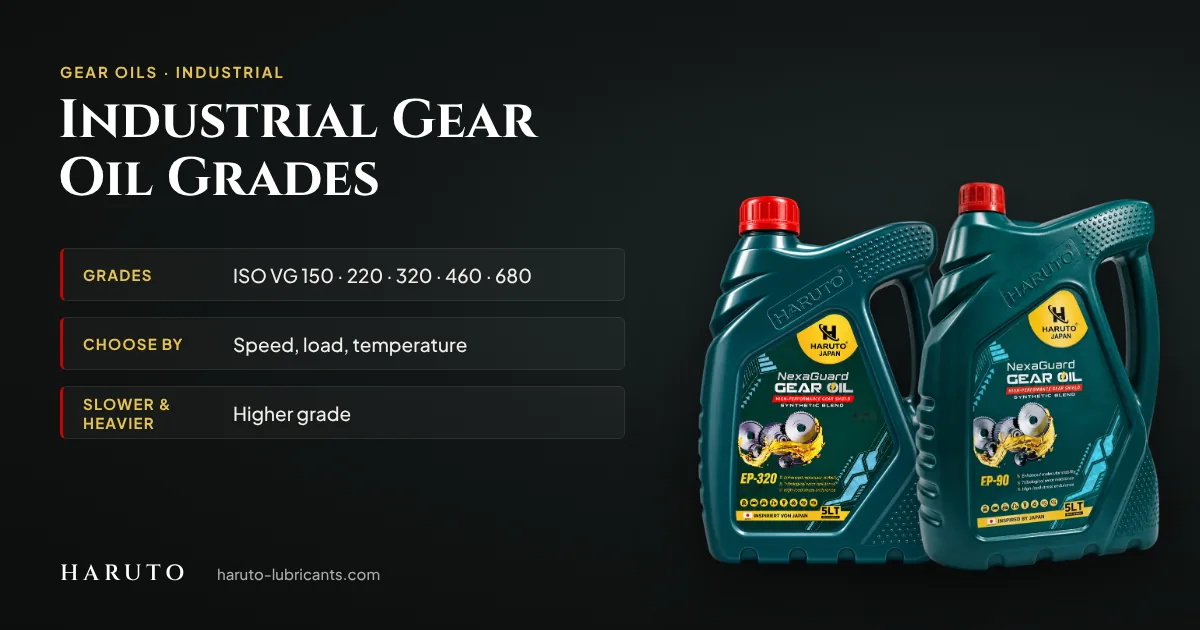
Most enclosed industrial gearboxes in India run on one of five oil grades: ISO VG 150, 220, 320, 460 or 680. Pick too thin and the gear teeth wear and pit. Pick too thick and the gearbox runs hot, wastes power and churns the oil. This guide explains what the numbers mean and how maintenance teams choose between them.
What ISO VG means
ISO VG (viscosity grade) is the oil’s kinematic viscosity at 40 °C, in centistokes (cSt). Each number is the middle of a band that allows 10% either side:
| ISO VG | Viscosity at 40 °C (cSt) |
|---|---|
| 150 | 135 – 165 |
| 220 | 198 – 242 |
| 320 | 288 – 352 |
| 460 | 414 – 506 |
| 680 | 612 – 748 |
Every step up is roughly 50% thicker. That is a big jump, which is why the right grade matters.
How gearboxes decide the grade
Gear teeth need an oil film thick enough to keep the metal apart where they mesh. Three things decide how thick that film must be:
- Speed. Fast gears drag oil into the mesh easily; slow gears do not. Slower gears need a higher grade.
- Load. Heavy and shock loads squeeze the film thin. Heavier loads need a higher grade, and usually EP additives.
- Temperature. Oil thins as it heats. A hotter gearbox needs a higher grade to keep the same film.
| Typical duty | Usual range |
|---|---|
| High-speed, lightly loaded enclosed gears | ISO VG 150 – 220 |
| General helical and bevel gearboxes: conveyors, mixers, pumps, extruders | ISO VG 220 – 320 |
| Slow, heavily loaded or hot gearboxes: mills, crushers, kiln drives | ISO VG 320 – 460 |
| Worm gearboxes | ISO VG 460 – 680 (often compounded or synthetic) |
| Open gears (girth gears, kiln rings) | Open-gear compounds, not normal gear oil |
These are typical ranges. The gearbox maker’s plate or manual comes first.
Indian plant examples
- Cement. Crusher, mill and kiln-drive gearboxes run slow, hot and heavily loaded, often on ISO VG 320 or 460 with EP. Dust sealing and breather condition matter as much as the grade.
- Steel and rolling mills. Shock loads and water near the stands call for EP gear oils with good water separation.
- Sugar mills. Seasonal running, heavy mill drives and water from cane washing. Check for water every week in season, and store the oil properly in the off-season.
- Plastics and extrusion. Extruder gearboxes commonly run ISO VG 220 or 320; temperature and noise trends warn of trouble early.
- Cooling towers. Gearboxes sit in wet air. Water ingress is the usual failure; watch for milky oil.
EP or non-EP?
EP (extreme-pressure) gear oils carry additives that protect teeth when the oil film breaks down under shock or heavy load. Most enclosed industrial gearboxes use EP oils. Two cautions:
- Worm gears with bronze wheels. Some EP chemistries can attack yellow metals at high temperature. Many worm gearboxes use a compounded (non-EP) oil or a synthetic. Follow the maker.
- Synthetic oils. Some synthetic gear oils (polyglycols, PAG) do not mix with mineral oils and can attack some paints and seals. Never top up a PAG gearbox with mineral oil, or the other way round.
Automotive grades vs industrial grades
Automotive gear oils are graded by SAE (for example 90 or 140); industrial gear oils by ISO VG. They are different scales. As a rough guide only, an SAE 90 sits around ISO VG 150–220 and an SAE 140 around ISO VG 320–460. That is close enough to understand a label, but not a reason to swap one for the other: automotive and industrial gear oils use different additive packages. Read our GL-4 vs GL-5 guide for the automotive side.
Signs the grade or the oil is wrong
- Gearbox running noticeably hotter than before, or above its usual temperature.
- New whining or knocking noise; pitting or polished bands on the teeth at inspection.
- Oil darkening fast, smelling burnt, or forming sludge on the dipstick.
- Milky oil (water), or foam at the sight glass.
- Seal leaks after a change of oil type.
Change intervals and condition checks
Mineral gear oils in clean, cool enclosed gearboxes often last thousands of running hours; hot, dusty or wet gearboxes need much shorter intervals. Rather than guessing, use the maker’s interval as an upper limit and check condition:
- Weekly: level, temperature (a hand-held thermometer is enough), noise, leaks, breather.
- Monthly: oil colour and clarity at the sight glass; drain a little from the bottom to look for water.
- For critical gearboxes: oil analysis for viscosity, water, wear metals and particles.
Top-ups, mixing and storage
- Top up with the same grade and type. Mixing two mineral EP oils of the same grade is usually tolerated in an emergency; mixing mineral with synthetic often is not.
- Label every gearbox with its oil grade and type.
- Store drums indoors or covered, bungs tight, and use clean, dedicated transfer containers.
Haruto gear oils run from EP-90 to EP-680, for automotive axles and gearboxes and for industrial gear drives.