Hydraulic Oil Problems: Overheating, Foaming, Milky Oil and What to Do
When a hydraulic machine runs hot, turns sluggish or gets noisy, the oil usually gets the blame. Sometimes it really is the oil. More often the oil is showing a problem somewhere else in the system. This guide goes through the five most common oil complaints, what each one usually means, and what to check before changing anything.
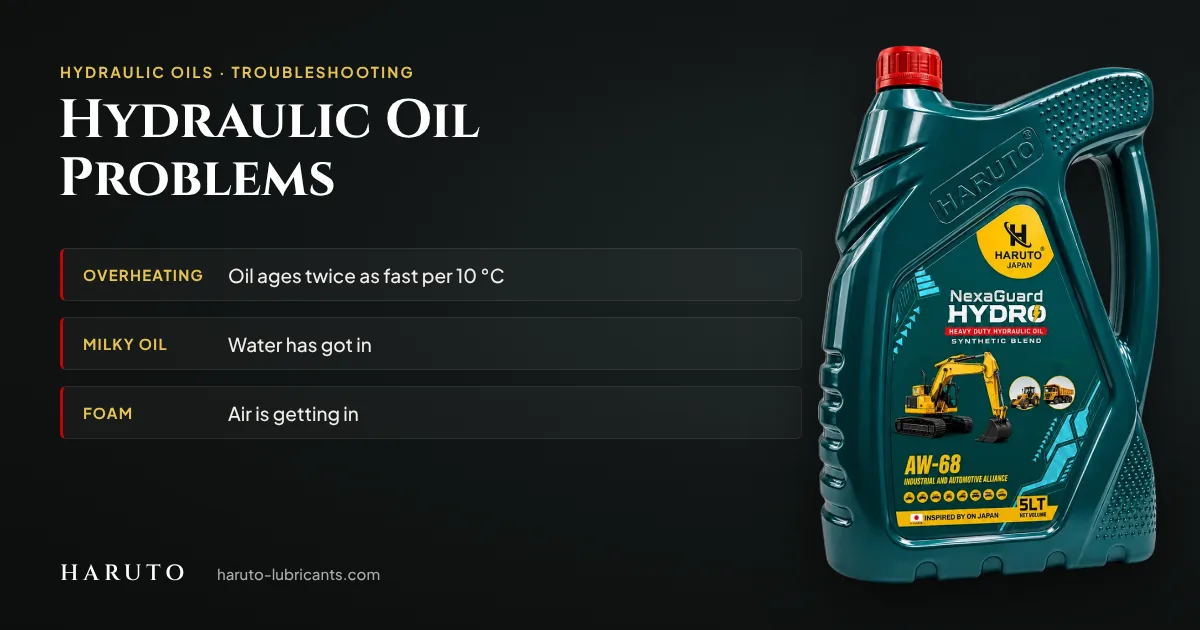
Quick guide: symptom, cause, first check
| What you see | Usual causes | First check |
|---|---|---|
| Oil running hot | Blocked cooler, low level, relief valve bypassing, worn pump, wrong grade | Oil level and cooler fins; temperature at tank |
| Foam in the tank | Air leaking into the suction line, low level, return line above the oil, contamination | Level; suction fittings; return pipe position |
| Milky or cloudy oil | Water from condensation, washdown, rain or a cooler leak | Sample in a clear bottle; look for free water at tank bottom |
| Dark oil, burnt smell | Overheating, oxidation, air bubbles being compressed | Temperature history; age of oil |
| Sticky deposits, sludge | Old oil, mixed oils, overheating | Strainer and filter condition |
1. Hydraulic oil overheating
Most industrial hydraulic systems are designed to run with the tank oil at roughly 40 to 60 °C. Above about 60 °C the oil ages much faster: a common rule of thumb is that the oxidation rate doubles for every 10 °C rise. Hot oil is also thinner, so pumps and valves leak more internally, which makes even more heat.
Common causes:
- Cooler fins choked with dust or oil mist; cooling water flow too low.
- Oil level low, so the oil circulates too fast to cool.
- Relief valve set too low or bypassing, so oil is constantly dumped across it.
- Worn pump or cylinder seals leaking internally.
- Oil grade too thin (or too thick) for the system and climate.
- Machine working in hot ambient air without enough ventilation.
Fix the cause, not just the oil. Changing to a thicker grade can hide a worn pump for a few weeks, but it does not cure it. See the temperature windows for each grade in our AW32 vs AW46 vs AW68 guide.
2. Foaming and aeration
A little surface froth that clears quickly is normal on some tanks. Stable foam, or cloudy oil full of tiny bubbles, is not. Air in the oil makes pumps noisy (a gravel-like sound), makes actuators spongy, and heats the oil when the bubbles are compressed.
- Air leaks on the suction side: loose clamps, cracked hoses, a worn pump shaft seal. Air is sucked in, not pushed in.
- Low oil level, so the suction draws in air or the return splashes.
- Return line ending above the oil level, whipping air into the tank.
- Contamination: water, grease or another oil can spoil the oil’s ability to release air.
- Old oil, whose anti-foam additive is used up.
3. Milky or cloudy oil (water)
Hydraulic oil turns milky when water is mixed into it as tiny droplets. Common sources are condensation in tanks that heat and cool every day, pressure-washing near breathers, rain through open fill caps and leaking water-cooled heat exchangers.
Simple checks on site:
- Fill a clean glass bottle and let it stand for a day. Free water settles at the bottom; a milky layer that does not clear means emulsified water.
- Drain a little from the bottom of the tank; free water often comes out first.
- “Crackle test”: a drop on a hot plate that spits and crackles usually contains water.
Water causes rust, attacks some additives, and shortens pump and bearing life. Remove the source first, drain free water, and replace or dehydrate the oil. A desiccant breather helps on tanks in humid or washdown areas.
4. Dark oil and a burnt smell
Oil darkens slowly with age, which is normal. Fast darkening with a sharp burnt smell points to overheating, or to air bubbles being compressed so hard that they scorch the oil (sometimes called “micro-dieseling”). Treat the heat or air problem, then change the oil and filters.
5. Sludge, varnish and sticky valves
Old, oxidised oil leaves gummy deposits on valve spools, strainers and tank walls. Mixing different oils can do the same. Symptoms are sticking valves, slow or jerky movement and blocked suction strainers. A proper drain, clean-out and new oil are needed; topping up with fresh oil on top of sludge does not fix it.
Contamination and filters
Dirt causes more hydraulic failures than anything else. Cleanliness is often written as an ISO code such as 18/16/13 — three numbers for particle counts at three sizes; lower numbers mean cleaner oil. You do not need a lab every week, but you do need to:
- Change filters when the indicator says so, not “when convenient”.
- Filter new oil when filling; new oil from a drum is not always clean enough for servo or proportional valves.
- Keep breathers, caps and fill points closed and clean.
When to change the oil, and when to fix the machine
| Situation | Action |
|---|---|
| Oil past its interval, otherwise healthy machine | Change oil and filters |
| Milky oil, source found and fixed | Drain, flush if heavily affected, refill |
| Running hot after a good oil change | Check cooler, relief valve, pump wear |
| Foam with fresh oil | Find the air leak or level/return problem |
| Sludge and sticky valves | Drain, clean tank and strainers, flush, refill |
A short flushing routine
- Drain the oil warm, from the lowest point.
- Clean the tank by hand; lint-free cloths, no cotton waste.
- Change all filters; clean suction strainers.
- Fill with fresh oil, run the machine through all functions at low load, then drain or filter again if the system was very dirty.
- Refill, bleed air, check level with cylinders in the position the manual specifies.
Prevention checklist
- Use the grade the machine maker specifies for your climate.
- Check level and temperature daily on hard-working machines.
- Keep coolers clean and breathers in good condition.
- Never top up with engine oil, gear oil or a different hydraulic oil type.
- Label every machine with its oil grade.
Haruto hydraulic oils come in AW 32, AW 46 and AW 68 for presses, moulding machines, machine tools and earthmovers.