Hydraulic Oil for JCB & Excavators: Which Grade?
The hydraulics are the heart of a JCB, excavator or backhoe — they do the digging, lifting and steering. The wrong hydraulic oil means overheating, sluggish operation, pump wear and seal failure. Here is how to choose the right grade for construction equipment in India.
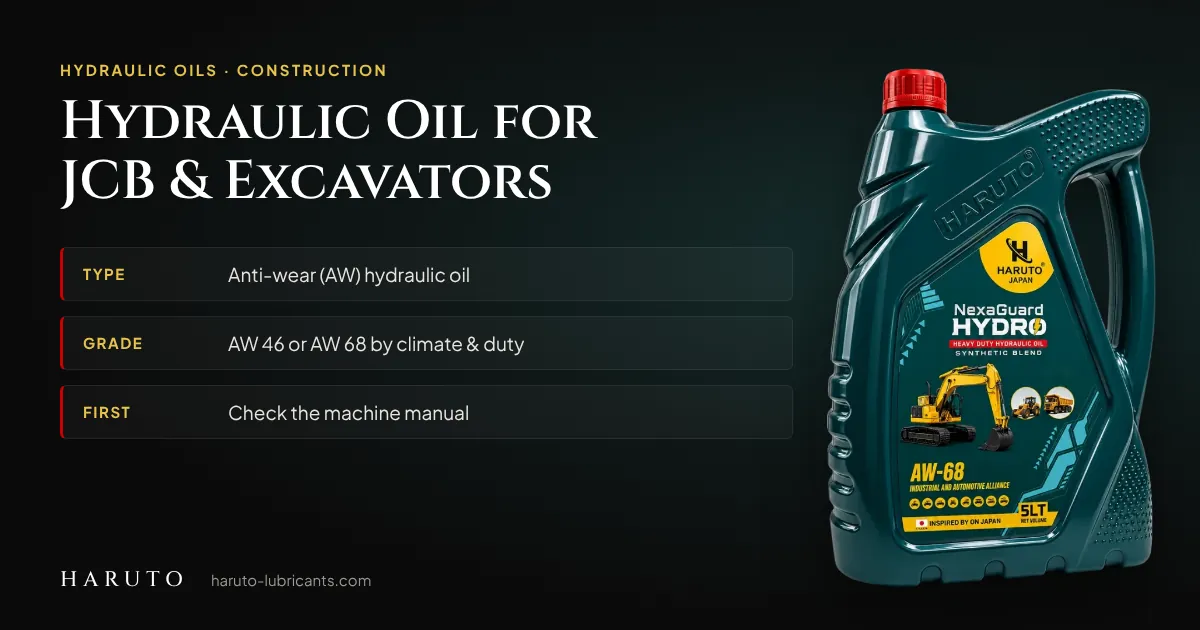
Construction hydraulics need anti-wear (AW) oil
Earth-moving machines run high-pressure piston and gear pumps, so they need a proper anti-wear hydraulic oil meeting DIN 51524 Part 2 (HLP) / ISO 11158 HM — not a plain circulating oil. The AW additive package is what protects the pump under load.
AW 46 or AW 68?
The number is the ISO viscosity grade. In India’s climate, most earth-moving equipment runs AW 68 because the machines and ambient temperatures run hot and the higher viscosity holds a protective film. AW 46 suits cooler conditions or where the maker specifies it. Always follow the OEM manual first.
| Grade | Best for |
|---|---|
| AW 46 | Cooler regions / lighter duty, or where OEM specifies |
| AW 68 | Hot ambient + heavy digging — the common choice for Indian earth-moving |
What the numbers mean: ISO VG and viscosity index
ISO viscosity grades are bands, not single values. Each grade covers 10% either side of its mid-point, measured at 40 °C:
| Grade | Viscosity at 40 °C | What it means on site |
|---|---|---|
| ISO VG 46 | 41.4–50.6 cSt | Thinner: quicker flow on cold starts, less film margin when very hot |
| ISO VG 68 | 61.2–74.8 cSt | Thicker: holds its film better when hot, slower when cold |
A working machine does not run at 40 °C, though. On a summer afternoon in Gujarat or Rajasthan the oil typically runs well above that, and oil thins as it heats. VG 68 starts thicker, so it is still thick enough at working temperature to protect the pump and limit internal leakage.
Viscosity index (VI) describes how much an oil's viscosity changes with temperature. The higher the VI, the less the oil thins when hot and thickens when cold; high-VI (HVLP) oils hold their viscosity across a wider range than conventional mineral AW oils. That matters on a Punjab winter site or a hill-road project in Himachal, where a machine may start in single-digit temperatures. Cold, thick oil struggles to reach the pump inlet, which shows up as pump noise and sluggish controls in the first minutes.
A note on multi-grade & UTTO
Some newer machines specify a high-VI (HVLP) or multi-grade hydraulic oil for a wider temperature range, and certain backhoe loaders share one oil across the transmission and hydraulics (a UTTO-type fluid). Check whether your machine wants a dedicated hydraulic oil or a combined fluid — don’t assume.
Contamination: what actually kills hydraulic pumps
The oil grade gets the attention, but dirt and water do the damage. Pumps and control valves work with clearances measured in microns. Fine site dust, wear metal and water wear those surfaces, score valve spools and make controls drift.
Where contamination gets in
- The tank breather. As cylinders extend, the tank breathes in outside air; a missing or clogged breather filter lets dust in with it.
- Cylinder rods. Worn wiper seals let dust stuck to the rod get dragged into the cylinder.
- New oil. Drum oil is not automatically clean enough; filtering it in is good practice.
- Condensation. Hot days followed by cool, humid monsoon nights form water inside the tank and in half-empty drums.
Cleanliness codes in plain terms
Oil cleanliness is reported as an ISO 4406 code: three numbers such as 18/16/13. They describe how many particles sit in each millilitre of oil at three sizes — 4, 6 and 14 microns and above. Each step up in a number roughly doubles the particle count. You do not need to memorise targets: ask the machine maker or filter supplier what code your machine should run at, and use oil analysis to check it.
Topping up without contaminating the system
- Read the level with the machine in the check position the manual shows, and release tank pressure as the manual describes — many excavator tanks are pressurised.
- Wipe the filler cap and surrounding area, and the drum bung or pail spout, before opening either.
- Pour through a clean, covered funnel kept only for hydraulic oil — never the one used for diesel or engine oil — or, better, a hand pump with an inline filter.
- Fill to the mark, not above it, and refit the cap firmly.
- Log how much you added. Frequent top-ups mean a leak that needs finding.
Hydraulic symptoms and what they usually mean
| Symptom | Common causes | First checks |
|---|---|---|
| Slow or weak cylinders | Low level, oil thinned by overheating, worn pump, internal leakage, clogged suction strainer | Level, oil temperature, filter indicator |
| Whining or rattling pump (cavitation) | Pump starved of oil: low level, cold thick oil, blocked strainer, collapsed suction hose | Level, warm-up routine, suction side |
| Overheating | Blocked oil cooler, low level, wrong grade, functions held against relief | Clean cooler fins, level, grade |
| Foam or bubbles in the sight glass | Air drawn in at a loose suction fitting, low level, mixed or contaminated oil | Level, suction fittings, recent top-ups |
| Milky oil | Water from washing, rain through a loose cap, or condensation | Change the oil and find the entry point |
| Jerky movement or boom drifting down | Air in the system, contaminated or worn valves, cylinder seal leakage | Bleed air, oil condition, cylinder check |
On Indian sites the oil cooler collects dust, cotton fluff and crop chaff quickly, and blocked fins push oil temperature up even with the correct grade. Blowing it out against the airflow direction is one of the cheapest ways to protect the pump. Operators help too: holding the boom against its stop keeps the relief valve open and turns engine power into heat.
Change intervals
Follow the machine’s hour-based interval, and change sooner in dusty, wet or heavy-duty conditions. Watch for signs of trouble — milky oil (water), a burnt smell (overheating), or sluggish, jerky hydraulics.
Oil changes, filter changes and mixing oils
Oil and filters work as a pair: changing the oil but not the filters puts clean oil through dirty filters. Most excavators and backhoe loaders have several:
- Return-line filter — catches wear particles on their way back to the tank; typically the most frequently changed.
- Suction strainer — a coarse mesh protecting the pump inlet.
- Pilot filter — protects the low-pressure pilot circuit that drives the joysticks.
- Tank breather filter — often forgotten, and the main dust entry point when ignored.
Many makers ask for an early first filter change on a new or rebuilt machine to catch assembly debris. After a pump or motor failure, new oil alone is not enough: the system needs flushing and every filter replacing, or debris from the old pump will damage the new one. If a filter indicator shows bypass, do not wait for the service date.
For fleets, oil analysis of a sample drawn at each service reports viscosity, water, particle count and wear metals, and catches a failing pump before it breaks.
Can you mix hydraulic oils?
An emergency top-up with the same type and grade from another supplier usually does no immediate harm, but AW additive systems differ — some zinc-based, some zinc-free — and mixing can sometimes cause deposits or foaming. Keep one oil per machine. If you switch, do it at a scheduled change: drain fully, change the filters, refill. Mixing VG 46 and VG 68 gives an in-between viscosity that defeats the reason for choosing the grade. Never top up with engine oil, gear oil or a UTTO unless the manual says that system runs on that fluid.
Daily walk-around checklist
Five minutes before the first shift catches most hydraulic problems while they are still small.
| Check | What good looks like | If not |
|---|---|---|
| Oil level (machine in check position) | Between the marks on the sight glass | Top up cleanly; investigate if it keeps dropping |
| Oil appearance | Clear and amber | Milky means water; dark with a burnt smell means overheating |
| Hoses and fittings | Dry, no rubbing, bulging or cracked covers | Tighten, re-route or replace before it bursts |
| Cylinder rods | Clean and shiny, no scoring, no oil ring | Replace wiper seals; check the rod for damage |
| Oil cooler | Fins clear of dust and chaff | Clean against the airflow direction |
| Filler cap and breather | Cap tight, breather clean | Replace the breather filter |
| Ground under the machine | No fresh drips | Trace the leak first |
| First minutes of work | Smooth, quiet, normal speed | Check level, warm-up and the suction side |
Storing hydraulic oil drums on site
A badly stored drum can be contaminated before its bung is ever opened.
- Keep drums under cover and off the ground on pallets or racks, away from welding work and direct sun.
- Store drums lying on their side with the bungs at roughly the 3 and 9 o'clock positions, so both stay below the oil level. A drum standing upright in the open collects rainwater on its lid, and daily heating and cooling can draw that water in past the bung.
- Label clearly and segregate hydraulic oil from engine, gear and transmission oils. Wrong fills on site usually start with an unlabelled drum.
- Use a dedicated drum pump, close the bung tightly after use, and work first-in, first-out.
Match pack size to consumption. A small site with one backhoe may be better served by 20 L or 26 L pails that are used up quickly, while a fleet yard can work from 210 L drums. Haruto NexaGuard hydraulic oils come in 1 L, 5 L, 10 L, 20 L, 26 L, 50 L and 210 L packs; for planning larger purchases, read our guide to buying hydraulic oil 68 in bulk.
Haruto hydraulic oils
Haruto’s anti-wear hydraulic range (AW 32, AW 46 and AW 68) covers construction and industrial machines in packs from 1 L to 210 L drums — see the hydraulic oils.