Best Engine Oil for Trucks & Buses in India (BS-VI)
For a commercial fleet, engine oil is a running cost and a reliability decision at the same time — the right oil protects the engine, holds up between long drain intervals, and can even save a little fuel. Here is how to choose the best engine oil for trucks and buses in India.
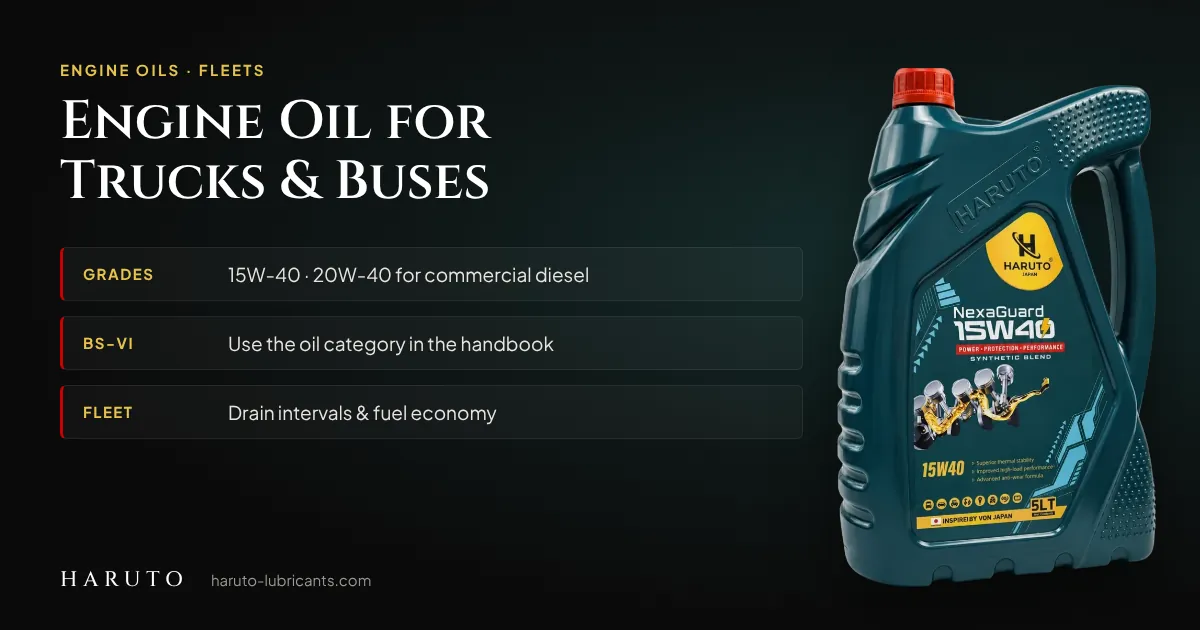
The common grades
Most Indian heavy-duty diesel engines run on 15W-40 — the all-round standard. 20W-40 still suits some older engines and very hot regions, while newer BS-VI engines increasingly move to lighter, fuel-efficient grades like 10W-30 or 5W-30 where the maker specifies them.
| Grade | Best for |
|---|---|
| 15W-40 | The heavy-duty standard for most trucks & buses |
| 20W-40 | Older engines, consistently hot regions |
| 10W-30 / 5W-30 | Newer BS-VI engines specifying low-viscosity oil for fuel economy |
API rating matters more on commercial engines
The API rating tells you how well the oil handles soot, heat and wear over long hours. For most trucks and buses, look for API CI-4; newer high-output and BS-VI highway engines may call for CK-4. Match the rating to the engine — a correct-viscosity oil with an outdated API rating is a false economy on a hard-worked engine.
BS-VI engines: a note on low-SAPS
BS-VI vehicles run exhaust after-treatment (DPF/SCR). Some require low-SAPS (low sulphated-ash, phosphorus, sulphur) oils to protect that hardware. Always check the handbook — using a non-specified oil in a BS-VI engine can shorten the life of expensive emissions components.
Running a fleet lubrication programme
The fleet tip above is worth taking further. A mixed fleet of older trucks, newer BS-VI tractor-trailers and a few buses can easily end up with eight or ten oils on the shelf — and every extra product is another chance for a fitter to pick up the wrong can on a night shift.
Build a grade matrix
List every vehicle model in the fleet, then write down what the handbook specifies for each compartment. Group vehicles that share a specification and choose one product per group. Most fleets end up with a short list along these lines:
| Compartment | Typical requirement (confirm in the handbook) |
|---|---|
| Engine, older and non-BS-VI | 15W-40 at API CI-4, or CH-4 where that is what the maker lists |
| Engine, BS-VI | The grade and API category in the handbook — often lower viscosity, sometimes low-SAPS |
| Rear axle and differential | Typically a GL-5 gear oil, such as SAE 90 or 140 in older vehicles |
| Tipper hoist and hydraulics | Anti-wear hydraulic oil, often ISO VG 68 for hot outdoor duty |
| King pins, spring shackles, propeller shaft | NLGI 2 or 3 grease suited to chassis work |
| Cooling system | The coolant type and mix ratio the maker specifies |
Haruto’s range covers these compartments with engine oils, EP-90 and EP-140 gear oils, AW hydraulic oils and chassis greases — useful when you want one supplier and one set of labels across the yard.
Keep records that mean something
- One line per service: date, vehicle number, odometer and engine hours, product and quantity, filters changed and who did the job.
- A separate top-up log for each vehicle, in litres.
- Colour-coded tags on every dispenser, jug and filler cap, so engine, gear and hydraulic oils cannot be confused.
Drain intervals & fuel economy
Follow the OEM drain interval, and shorten it for stop-start city buses, overloading or dusty routes, which age oil faster. A correctly-specified oil plus clean filters is the cheapest reliability you can buy on a commercial fleet, and the right low-viscosity grade on a BS-VI engine can trim fuel use by a small but real margin across a large fleet.
What Indian duty does to engine oil
Handbook drain intervals usually assume normal service. Very few Indian trucks and buses see normal service. Each common duty pattern attacks the oil in a different way, and knowing which ones your vehicles live with tells you what to watch.
| Duty | What happens to the oil | What to do |
|---|---|---|
| Overloading | More heat, blow-by, soot and oxidation; the oil darkens and thickens faster | Treat as severe service; watch temperature and oil consumption |
| Long idling at loading bays or for cabin cooling | The engine runs cool; fuel and moisture dilute the oil and soot builds with no kilometres on the clock | Track engine hours as well as kilometres; switch off instead of idling |
| Dusty highways and site roads | Fine silica that gets past a tired air filter or a cracked intake hose acts as grinding paste on liners, rings and bearings | Inspect the whole intake path; change air filters on condition, not only on schedule |
| City stop-start bus routes | Short hot spells, constant idling at stops, heavy braking; fuel dilution and sludge | Shorten the drain; keep the cooling system and injectors healthy |
A tipper that idles at the quarry, runs overloaded on a dusty access road and then climbs a ghat is in severe service on every count, whatever its odometer says.
Oil analysis basics for fleets
Used-oil analysis is a laboratory check on a small sample of in-service oil. For a fleet it answers two questions: is the oil still fit to use, and is the engine wearing normally? The trend across several samples from the same engine is worth far more than any single result.
Taking a good sample
- Sample a warm engine soon after shutdown, while contaminants are still in suspension.
- Take it from the same point every time — a sampling valve, or a clean tube pushed to mid-sump depth — never the first gush from the drain plug.
- Use a clean, dry bottle and label it with vehicle number, odometer or engine hours, kilometres on the oil and litres topped up.
Reading the report
| Result | What it usually points to |
|---|---|
| Viscosity well below grade | Fuel dilution or shear — check injectors and idling time |
| Viscosity well above grade or high soot | Overloading, injector faults, restricted air supply or too long a drain |
| Silicon | Dust entering through the intake — check the air filter, hoses and clamps |
| Sodium, potassium or glycol | Coolant leaking into the oil — act immediately |
| Iron, chromium, aluminium | Wear of liners, rings and pistons |
| Copper, lead, tin | Bearing wear; copper can also come from a new oil cooler |
| Base number (TBN) falling sharply | The oil’s acid-neutralising reserve is nearly used up |
Bulk storage and handling at the depot
Buying in 210 L drums or 50 L and 26 L packs cuts handling per litre, but a badly stored drum can do more damage than the saving is worth. Water and dust are the enemies, and both get in through the bungs. Oil drawn from a drum should always be clear and bright.
- Store under a roof. A drum left in sun and rain breathes: it warms by day, cools at night and draws humid air — and any water pooled on the lid — in past the bungs. The monsoon months are the worst.
- If drums must stay outside, lay them on their sides on a rack with the bungs at roughly 3 and 9 o’clock, so both sit below the oil level. Cover or tilt upright drums so water runs off the top.
- Keep everything sealed. Bungs tight, drum pumps capped, pail lids closed between uses.
- First in, first out. Write the received date on every drum and pail and issue the oldest stock first.
- Dedicated transfer equipment. One labelled pump, jug and funnel per product, stored closed. A jug used for gear oil today and engine oil tomorrow is how cross-contamination starts.
A fleet maintenance checklist
| When | Check |
|---|---|
| Daily or before each trip | Engine oil and coolant levels; leaks under the engine, gearbox and axle |
| Daily in dusty work | Air-filter restriction indicator, intake hoses and clamps |
| Weekly | Grease chassis points on hard-worked vehicles; check gearbox and axle breathers are clear |
| Every oil change | Oil and fuel filters; record litres and odometer; look at the drained oil for metal, milkiness or a fuel smell |
| Monthly | Review top-ups and breakdowns by vehicle — problem engines show up here first; walk the store and check FIFO |
| As per sampling plan | Oil analysis on representative vehicles to confirm or correct drain intervals |
Check the dipstick on level ground with the engine stopped for the settling time the handbook gives. Wipe it, push it fully home and read the second pull. Top up only to the upper mark — overfilling lets the crankshaft whip the oil into foam. A level that rises between checks means fuel or coolant is getting in: park the vehicle until the cause is found.
What to ask your oil supplier
- Which SAE grade and API category does each product meet, and is that printed on the pack?
- Is there a product data sheet with typical values (viscosity, viscosity index, flash point, base number) that matches the label?
- For BS-VI vehicles: is the oil suitable for engines with DPF and SCR after-treatment, and which specification does it meet?
- Are packs sealed and batch-coded, so a problem can be traced back?
- Which pack sizes suit your volume — pails for a small depot, drums for a large one?
Vague answers on grade, rating or traceability are a reason to keep looking. Haruto NexaGuard engine oils come in 500 ml, 1 L, 5 L, 7.5 L, 10 L, 20 L, 26 L, 50 L and 210 L packs, so a depot can buy to its real consumption.
Haruto for fleets
Haruto’s diesel engine oils cover the common commercial grades in bulk pack sizes, with distributor and fleet pricing — talk to us about fleet supply.