15W-40 vs 20W-40 Engine Oil: Which Should You Use?
15W-40 and 20W-40 are the two most common diesel engine-oil grades on Indian shelves, and buyers often assume the “thicker” one must protect better. It is not that simple. Both carry the same ‘40’ hot rating, so at operating temperature they behave almost identically. The real difference shows up on a cold start.
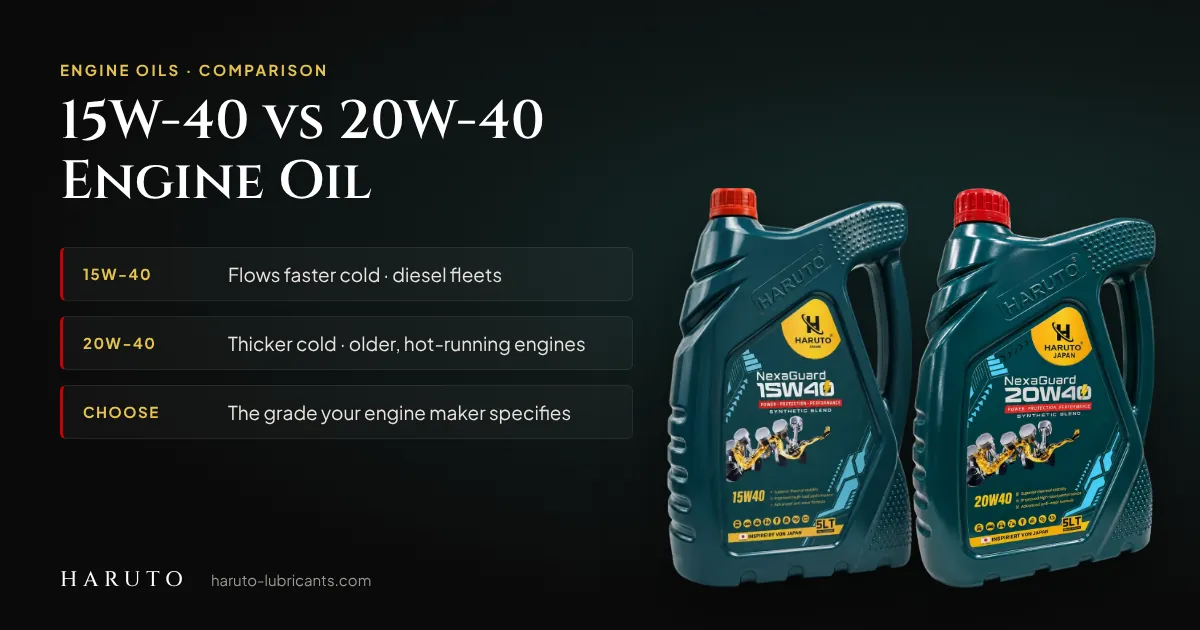
What the numbers mean
Both are SAE multigrade oils. The number before the W (winter) — 15W or 20W — describes how easily the oil flows when cold; the number after — 40 for both — describes its thickness at engine operating temperature. So a 15W-40 and a 20W-40 are effectively the same oil when hot; the 15W simply pumps a little faster on a cold morning.
What SAE J300 actually tests behind each number
The grades come from SAE J300, the standard that defines every engine-oil viscosity grade. The W number is not a temperature you read off the pack; it means the oil passed two cold tests at a set temperature. The cold-cranking test checks that the oil is thin enough for the starter to turn the engine, and the pumping test checks that the oil pump can still pull it through the strainer without starving the bearings. The hot number is a band of kinematic viscosity measured at 100 °C, plus a minimum high-temperature, high-shear (HTHS) viscosity at 150 °C that protects bearings and the cam train under load.
| SAE J300 limit | 15W-40 | 20W-40 |
|---|---|---|
| Cold-cranking (max 7,000 / 9,500 mPa·s) | at −20 °C | at −15 °C |
| Pumping (max 60,000 mPa·s, no yield stress) | at −25 °C | at −20 °C |
| Kinematic viscosity at 100 °C | 12.5 to below 16.3 cSt | 12.5 to below 16.3 cSt |
| HTHS viscosity at 150 °C (minimum) | 3.7 mPa·s | 3.7 mPa·s |
Two things follow. First, the hot rows are identical, which is why both oils protect the same once the engine is warm. Second, both cold limits sit far below anything most of India sees. The practical difference is not whether the engine will start; it is that a 20W-40 is thicker at every temperature below operating heat, so on a 10 °C morning it takes a little longer to reach the turbocharger, the cam and the top of the engine. Two oils can both carry the ‘40’ label and still differ inside that 12.5–16.3 cSt band, so compare the 100 °C figure on the data sheets when you want a like-for-like swap.
15W-40 vs 20W-40 at a glance
| Property | 15W-40 | 20W-40 |
|---|---|---|
| Cold-start flow | Better (flows sooner) | Slightly slower when cold |
| Hot-engine protection | Same (‘40’) | Same (‘40’) |
| Best for | Modern engines, cooler starts, all-round use | Older / higher-mileage engines, consistently hot regions |
| Oil consumption | Normal | Can suit engines that burn a little oil |
When to choose 15W-40
For most modern diesel engines — cars, tractors, light commercial vehicles — 15W-40 is the sensible default. Its better cold flow means faster lubrication at start-up, which is when most engine wear happens.
When 20W-40 makes sense
20W-40 suits older or high-mileage engines with a little more internal clearance, and hot regions where cold starts are never really cold. The slightly heavier cold grade can also help an older engine that consumes a bit of oil.
Indian temperatures and stop-start running
Most of peninsular and western India rarely sees a winter morning anywhere near freezing, and summer ambient in Rajasthan, Gujarat and central India typically runs well above 40 °C. At those temperatures either grade starts the engine easily. The cases where 15W-40 earns its place are narrower but real:
- North Indian winters. Punjab, Haryana, Uttar Pradesh and northern Rajasthan can drop close to freezing at dawn. Trucks parked overnight and tractors started at first light benefit from the faster cold flow.
- Hill routes. Vehicles running to Himachal, Uttarakhand, Kashmir, Ladakh or Sikkim regularly see sub-zero mornings. Here the manual may call for a lower W grade still, so check it before the season starts.
- Stop-start city running. A delivery van, school bus or city LCV that makes many short trips spends a large share of its life below full operating temperature. Every cold or half-warm start is a moment when the thinner cold grade reaches the bearings sooner.
- Frequent-start machines. Gensets on standby duty and pump sets that start and stop through the day go through many dry starts. The cold-side grade matters more for them than their running hours suggest.
Heat is a different problem. In a Rajasthan summer neither grade is ‘too thin’ — both are 40 when hot. What heat punishes is oil oxidation and low oil level, so in hot running focus on the correct performance level, a clean radiator and keeping the sump topped up, not on moving from 15W to 20W.
Signs the wrong grade is in the engine
A wrong grade rarely causes a sudden failure. It shows up as small symptoms that drivers and mechanics learn to ignore. Watch for these:
- Too heavy for the conditions: slow cranking on cold mornings, the oil-pressure warning light staying on longer than usual after a start, tappet or valve-train noise for the first minute, and harder starting on hill routes.
- Too thin or thinned in service: hot idle oil pressure lower than it used to be, rising oil consumption, a dipstick that looks watery and smells of diesel (fuel dilution), or a hot engine that sounds louder than normal.
- Wrong performance level rather than wrong grade: heavy sludge under the rocker cover, sticky deposits, or oil that turns thick and tarry well before the change is due. These usually point to an outdated API category or an overextended drain, not to the 15W versus 20W choice.
Does one give better mileage?
Not meaningfully. Because both are ‘40’ when hot, fuel economy is nearly identical. Any difference comes from using the manufacturer-specified grade and keeping to clean-oil service intervals — not from jumping between 15W-40 and 20W-40.
Field checks: dipstick, blotter spot and oil consumption
You do not need a laboratory to learn a lot about the oil in your engine. Three simple checks, done at the same point in every service, tell you whether the grade and drain interval suit your duty.
- Dipstick look and feel. Diesel oil turns black within hours because it holds soot in suspension; colour alone is not a reason to change. Worry instead about a milky or coffee-coloured look (water or coolant), a strong diesel smell or watery feel (fuel dilution), grit between the fingers (dust ingress), or oil that is thick and sticky.
- Blotter spot test. With the engine warm, place one drop of oil from the dipstick on plain white filter paper and leave it flat for a few hours. A spot that spreads evenly with a soft grey centre means the oil is still dispersing soot. A dense black centre with a hard edge, or a clear ring around a dark core, means the dispersant is used up and the oil is due, or overdue, for a change.
- Oil consumption log. Record every top-up against kilometres or engine hours. A steady figure is normal; a rising trend points to wear, a leak, or oil that has thinned. Compare against the allowable consumption in the engine manual.
For fleets, tractor groups and genset users, a periodic oil analysis report goes further. The key lines to read are viscosity at 100 °C (it should stay inside the 12.5–16.3 cSt band for a 40 grade), soot, fuel dilution, water, silicon (dust getting past the air filter — very common on Indian sites), wear metals such as iron, copper and lead, and the remaining base number. A rising viscosity means oxidation or soot loading; a falling one usually means fuel dilution or shear.
Drain intervals, top-ups and mixing grades
The drain interval is set by the engine maker for a given duty, not by the grade on the can. 15W-40 and 20W-40 of the same performance level are typically changed at the same interval. What changes the interval is how the engine works: dusty roads, overloading, long idling, short-trip city running and poor-quality fuel all count as severe service, and many manuals give a shorter interval for it. Tractors, gensets and pump sets are serviced on engine hours, so keep the hour meter working.
On top-ups, the rules are simple:
- Adding some 20W-40 to an engine filled with 15W-40, or the reverse, in an emergency is safe. The blend simply sits between the two cold grades and is still a 40 when hot.
- Oils of the same API category from different brands are formulated to be compatible, so a top-up from another brand will not harm the engine. Go back to your chosen oil at the next change.
- Do not keep switching grades change after change. Pick the one the manual allows for your conditions and stay with it so your consumption and analysis records stay comparable.
For workshops and fleet stores, standardising on one grade where the manuals allow it cuts stock, mistakes and part-used drums. Haruto NexaGuard engine oils are available in both 15W-40 and 20W-40, in packs from 500 ml and 1 L for top-ups up to 20 L, 26 L, 50 L and 210 L for workshop and fleet use.
Quick decision checklist
- Read the manual first. If it lists one grade, use it. If it gives a temperature chart, find your coldest typical start temperature on it.
- Match the performance level. Confirm the API category (for example CH-4 or CI-4) on the pack meets or exceeds the manual. See our guide to API CI-4 vs CH-4 vs CK-4.
- Think about cold starts. North Indian winters, hill routes, city stop-start work and standby gensets lean towards 15W-40.
- Think about engine age. An older engine that the manual or your mechanic has long run on 20W-40 can stay on it in warm regions.
- Set the drain by duty, not by grade. Use the severe-service interval for dusty, overloaded or short-trip work.
- Track it. Log top-ups, do a blotter spot at each service and use oil analysis on high-value engines.
For more on how viscosity grades work across all engine types, read our engine oil viscosity guide.