Which Grease for Wheel Bearings, Chassis & High Temperature?
“Grease” is not one product. The right grease depends on the load, temperature, water exposure and speed of the part you are lubricating. Use the wrong one and you get bearing failure, wash-out or hardening. Here is how to pick by application.
What makes greases different
A grease is base oil held in a thickener (soap), rated for consistency by an NLGI grade (0 = soft, 2 = standard, 3 = firm). The thickener type — lithium, lithium-complex, calcium, polyurea — sets its temperature and water resistance. EP (extreme-pressure) versions add load-carrying additives.
| Application | Typical choice |
|---|---|
| Wheel bearings | Lithium-complex, NLGI 2/3, high drop-point (handles brake heat) |
| Chassis (pins, bushes, linkages) | Lithium / MP grease, NLGI 2, often EP |
| High temperature | Lithium-complex or polyurea, high drop-point |
| Wet / washdown | Calcium-sulphonate or water-resistant lithium-complex |
| Heavy load / shock | EP grease (EP 2), or moly-fortified |
Wheel bearings vs chassis — the common mix-up
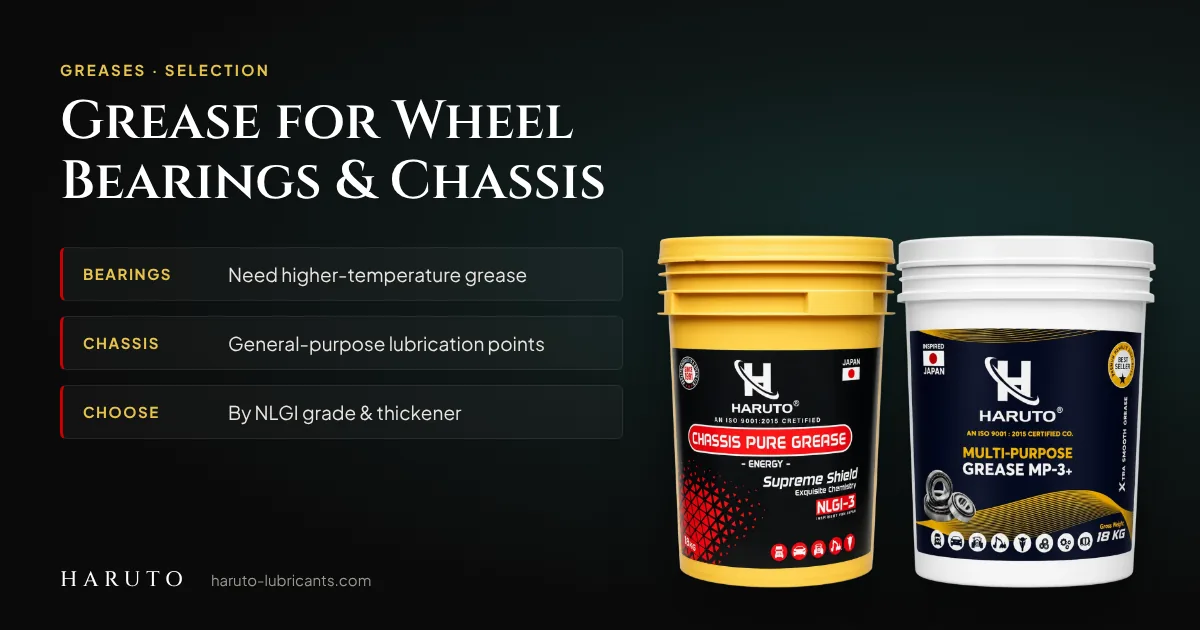
Wheel bearings run hot (brake heat) and fast, so they need a grease with a high drop-point — lithium-complex NLGI 2 or 3 is the standard. Chassis points (kingpins, tie-rods, spring shackles) take shock loads at low speed, so a general-purpose or EP lithium grease at NLGI 2 is ideal. Using a soft chassis grease in a hot wheel bearing can let it soften and run out.
How to repack a wheel bearing
On vehicles with serviceable taper-roller hubs — many trucks, buses, trailers and tractors, and older cars — repacking is when the grease choice actually pays off. The sequence below is the general method; torque figures, end-play and any special steps come from the vehicle’s service manual.
- Remove the hub and take out the inner and outer bearings. Keep each bearing with its own race and wheel.
- Clean everything. Wash the bearings, races and hub cavity in a suitable solvent until all old grease is gone. Let the parts dry, or blow air through them without letting the bearing spin — spinning a dry bearing with compressed air damages it.
- Inspect. Look for pitting, flaking, blue or straw-coloured discolouration from overheating, rust and roller marks on the races. Any of these means replacing the bearing and its race as a set.
- Pack the bearing. Force grease into the cage from the wide end until it comes out between the rollers on the other side, all the way round — by hand in the palm or with a bearing packer. Smearing grease on the outside is not packing.
- Coat the races and hub. Grease the races and put a moderate amount in the hub cavity. Do not fill the hub solid; follow the manual on how much.
- Fit new seals. Old seals rarely survive removal, and a damaged seal lets water and dust straight in.
- Adjust and lock. Set preload or end-play exactly as the manual specifies, then fit a new split pin or locking device.
- Check after the first run. Feel the hub temperature after a short drive and look for grease on the wheel or brake parts.
How much grease is enough
Too little grease starves a bearing, but too much is just as common and is often blamed on the grease itself. An overfilled hub or bearing housing churns the grease, builds heat and forces grease past the seals — onto brake linings, drums and discs, where it contaminates the friction surfaces and weakens braking.
- Wheel bearings: pack the bearing fully, coat the races and leave space in the hub cavity. The vehicle manual says how much goes in the hub and the hub cap.
- Chassis points: pump until fresh grease just appears at the joint edges or old grease is pushed out. On rubber-booted joints, stop when the boot just starts to swell — a burst boot lets in dirt and water.
- Bearing housings with a relief plug: remove the plug while greasing so the excess can escape.
A bearing that runs warm just after greasing and then settles as the excess is thrown out was slightly overfilled. One that keeps getting hotter needs checking straight away.
How to choose in three steps
- Temperature: hot (bearings, near brakes/engines) → high drop-point lithium-complex or polyurea.
- Load: shock or heavy load → EP grade.
- Water: washdown or wet sites → calcium-sulphonate or water-resistant grease.
Then match the NLGI grade (2 for most general use) and follow the equipment maker’s spec.
Greasing chassis points properly
Chassis points fail through neglect more often than through the wrong grease. Grease has to reach the loaded surfaces, and that does not happen if the nipple is blocked or the joint is carrying weight.
- Wipe every nipple before connecting the gun. Pushing dust into a kingpin is how bushes wear out.
- Take the weight off where needed. On kingpins and some suspension joints, lifting the axle on a jack lets grease spread across the bush and thrust surfaces instead of bypassing them. Turn the steering from lock to lock while greasing.
- Replace blocked nipples. If a nipple will not take grease, change it rather than skipping it. The skipped point is usually the one that seizes.
- Do not miss the less obvious points: spring pins and shackles, tie-rod and drag-link ends, propeller shaft universal and slip joints, clutch and brake linkages, the fifth wheel on tractor-trailers, and loader and boom pins on construction equipment.
- Keep a greasing chart for each vehicle type showing every point, so a new mechanic does not have to guess.
Intervals come from the manual — typically at every service for road vehicles, and often every shift or every day for backhoe loaders, excavators and tractors working with loaders. Dust, mud, water and overloading are all reasons to grease more often, not less.
Grease guns, buckets and storage in the workshop
Much of the dirt that ends up in a bearing or kingpin gets there before the grease reaches the vehicle — from an open bucket, a dirty gun or a dusty bench. A few habits keep it out.
- One gun per grease. Keep a separate, labelled gun for each grease in use. A shared gun mixes thickeners every time it is refilled.
- Load cleanly. Cartridges are the cleanest way to fill a gun. From a bucket, use a filler pump or the gun’s suction fill rather than scooping with a stick or a hand, and close the lid straight away.
- Bleed out the air. After loading, loosen the head or open the bleed valve and pump until grease comes out without spitting. A gun with an air pocket clicks without delivering, and the point gets missed.
- Know what one stroke delivers. Weigh the grease from ten strokes on a small scale. The greasing chart can then say “three strokes” instead of “some grease”, and the next mechanic does the same job.
- Look after the coupler. Wipe it before each use and keep it capped. Hang guns up rather than leaving them on the floor.
- Store buckets and kegs sealed, under cover and out of the sun. Mark the opening date and use the oldest stock first.
Indian conditions that change the choice
Most grease recommendations assume moderate conditions. Indian duty cycles push greases harder, and the choice should allow for it.
| Condition | What it does to grease | What to do |
|---|---|---|
| Summer heat, 45 °C ambient | Hubs start hotter, speeding oxidation and softening | Lithium complex in wheel hubs; NLGI 3 where the manual allows |
| Ghat roads and heavy braking | Brake heat soaks into the hub | High drop-point lithium complex; check hubs for leakage after hill routes |
| Monsoon water and wading | Washes grease out, emulsifies the rest, starts rust | Water-resistant grease; regrease chassis points after deep water |
| Dust in mines, quarries and cement plants | Abrasive dirt mixes in and grinds the joint | Shorter intervals; purge until clean grease appears; keep nipples capped |
| Overloaded tippers and trucks | Higher contact pressure on pins, bushes and bearings | EP grease, or moly-fortified grease on slow, heavily loaded pins |
| Tractors in paddy and wet fields | Long hours with pivots and axles in mud and water | Water-resistant grease and daily greasing of exposed points |
Signs your grease is failing
Check for these during routine service. Catching them early costs a regrease; missing them costs a bearing, a kingpin or a roadside breakdown.
- Hardened, dark or caked grease — oxidised by heat or left too long. Clean out and repack; consider a higher-temperature grease.
- Thin, runny grease leaking from the hub — excess heat, overfilling or an incompatible mix. Check the seal, the fill and what grease went in last.
- Milky or pale grease — water has got in. Replace seals if needed and move to a more water-resistant grease.
- Gritty grease — dirt contamination. Shorten intervals and check seals and boots.
- Rumbling, grinding or clicking from a wheel — the bearing may already be damaged. Inspect it rather than just adding grease.
- One hub clearly hotter than the others after a run — check bearing adjustment, brake drag and grease condition.
Matching the job to a Haruto grease
The Haruto grease range covers each duty above. Use this as a starting point and confirm against the equipment manual.
| Job | Haruto grease | NLGI grades |
|---|---|---|
| Wheel bearings, hot hubs | Lithium Complex | 2 / 3 for hubs (NLGI 1 also available) |
| General automotive and industrial bearings | Lithium MP | 2 / 3 |
| Chassis, pins and suspension, wet conditions | Red Gel HAX (chassis) | 3 |
| High-load bearings and gear couplings | EP Series | 00 / 0 / 1 / 2 / 3 |
| Wet, washdown and marine duty | Calcium Sulphonate | 1 / 2 / 3 |
| Electric-motor and sealed-for-life bearings | Polyurea | 2 / 3 |
For more on consistency, see NLGI grease grades explained; for upgrading hub grease, see lithium vs lithium complex; and before switching products, check the grease compatibility chart. Haruto greases come in tubes, jars, buckets and kegs — tell us the application and we will confirm the grade and available packs.