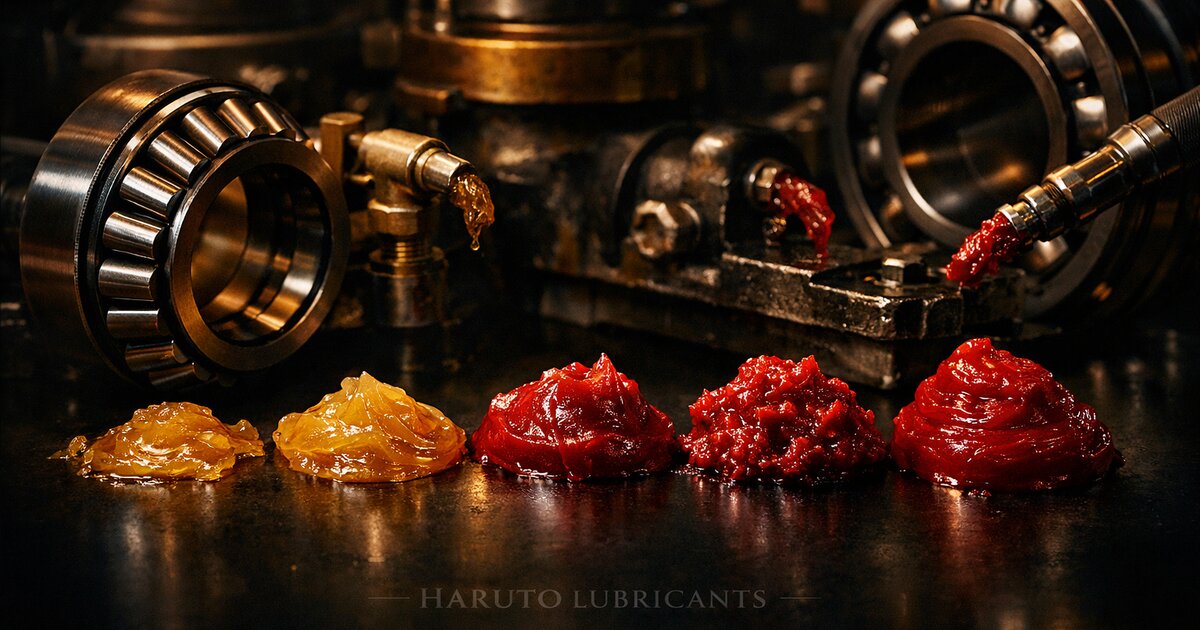
What Is NLGI Grade?
NLGI stands for the National Lubricating Grease Institute, the body that established the standard consistency classification for greases. The scale runs from NLGI 000 (almost fluid) to NLGI 6 (very hard, brick-like). In industrial and automotive practice, grades 0 through 3 cover the vast majority of applications.
Consistency is measured by the worked penetration test — a standardised cone is dropped into the grease and the depth of penetration (in tenths of a millimetre) is recorded. A higher penetration value means softer grease; a lower value means firmer. Each NLGI grade corresponds to a defined penetration range.
Simple analogy: Think of NLGI grades like butter. NLGI 00 is like cooking oil — almost pourable. NLGI 1 is like cold butter — soft but holds shape. NLGI 2 is like refrigerated butter — firm. NLGI 3 is like a hard cheese — stiff and stays put. Each has its place.
The Penetration Test and the Full Grade Scale
The test behind the grade is ASTM D217, with ISO 2137 as its equivalent. The sample is brought to 25 °C and worked with 60 double strokes of a perforated plunger in a standard grease worker, imitating the shearing it gets in a bearing. The cone is then released onto the surface for five seconds and its depth read in tenths of a millimetre. That figure, the worked penetration, fixes the grade:
| NLGI grade | Worked penetration (0.1 mm) | Consistency |
|---|---|---|
| 000 | 445–475 | Fluid |
| 00 | 400–430 | Semi-fluid |
| 0 | 355–385 | Very soft |
| 1 | 310–340 | Soft |
| 2 | 265–295 | Medium |
| 3 | 220–250 | Medium-firm |
| 4 | 175–205 | Firm |
| 5 | 130–160 | Very firm |
| 6 | 85–115 | Hard, block grease |
A grease reading 300 falls in the gap between NLGI 1 and 2 and is often sold as "NLGI 1–2". Data sheets may also list unworked penetration, measured as the grease sits in the container, and prolonged worked penetration after 10,000 or 100,000 strokes. A small change after prolonged working signals good mechanical stability: the grease will not soften and run out of a vibrating bearing or a wheel hub on rough roads.
The Common Grades and Their Applications
| NLGI Grade | Texture | Typical Application | Operating Temp |
|---|---|---|---|
| 00 / 0 | Semi-fluid | Centralized lube systems, gear housings, worm gears | -30°C to +120°C |
| 1 | Soft | Slow-speed bearings, cold climate applications, large bearings | -20°C to +130°C |
| 2 | Medium | General-purpose bearings, automotive wheel bearings, electric motors | -20°C to +140°C |
| 3 | Firm | High-speed spindles, vertical shaft bearings, extreme vibration | -10°C to +150°C |
NLGI 0 — Centralised Lube Systems and Gear Housings
Semi-fluid greases at NLGI 0 are used where oil would splash or escape but a pumpable lubricant is still required. Common applications include centralised automatic lubrication systems that feed multiple bearing points through small-diameter feed lines, and enclosed gear housings where the grease acts more like a very heavy oil, coating the gear faces as they rotate. These greases flow readily even at low temperatures, making them suitable for equipment in cold environments.
NLGI 1 — Large and Slow Bearings
Softer than the standard general-purpose grade, NLGI 1 is well-suited for large diameter bearings, slow-speed applications, and cold-climate machinery. The lower consistency ensures the grease flows into the bearing contact zone even when the rolling elements are moving slowly — an important factor where churning and heat generation are minimal. Agricultural equipment operating in winter conditions, and some paper mill roll bearings, commonly specify NLGI 1.
NLGI 2 — The Industry Standard
If there is a single "default" grease grade, it is NLGI 2. The majority of automotive wheel bearings, industrial ball and roller bearings, electric motor bearings, and general plant machinery call for NLGI 2. It provides the best balance of pumpability, retention in the bearing housing, and film strength across a wide temperature range. Haruto’s EP Series greases come in NLGI 2 (and in 00, 0, 1 and 3) for high-load bearings and gear couplings.
NLGI 3 — High Speed and Vertical Shafts
Where centrifugal forces, vibration, or gravity would cause a softer grease to migrate out of the bearing, NLGI 3 provides the firmness needed to stay in place. Common uses include high-speed spindle bearings, vertical shaft arrangements, and heavily vibrating equipment. The firmer consistency resists being flung out at high RPM, maintaining a consistent lubricating film at the contact zone.
Choosing the Grade by How the Grease Is Applied
Consistency has to suit the dispensing method as much as the bearing.
- Hand grease guns and cartridges. NLGI 2 is the easiest all-round grade to push through a gun and nipple. NLGI 3 takes more effort and struggles through long passages; very soft 00 and 0 grades can leak past the gun piston.
- Centralised lubrication systems. Progressive and single-line systems on tippers, excavators, crushers and plant conveyors push grease through long, narrow lines. They are typically designed for NLGI 000 to 1, with NLGI 2 allowed only on some systems with short lines in warm conditions. Too stiff a grease blocks distributors and starves points; follow the system maker's pumpability guidance.
- Single-point automatic lubricators. The canister type fitted to remote bearings typically takes NLGI 0 to 2; check the lubricator's own instructions.
- Grease-filled gearboxes. Some small enclosed gear units and geared motors are designed for semi-fluid NLGI 00 or 000, which stays in a housing that would leak oil. Use the grade on the gearbox plate, and never fill an oil-designed gearbox with grease.
Quick selection by application
| Application | Typical NLGI | What else to look for |
|---|---|---|
| Wheel bearings: cars, trucks, tractors | 2 or 3 | A high-dropping-point thickener such as lithium complex where braking heats the hub |
| Chassis: king pins, spring shackles, steering joints | 2, some specify 3 | EP additive and water resistance for monsoon running and washing |
| Propeller shaft universal and slip joints | 2 | EP additive for shock loads |
| Electric motor bearings | 2 or 3 | Lower base oil viscosity for speed; polyurea is common in sealed bearings |
| Centralised systems on vehicles and plant | 000 to 1 | Pumpability at the lowest temperature the system sees |
| Small grease-filled gearboxes | 00 or 000 | Semi-fluid EP grade, as stated on the gearbox plate |
| Slow, heavily loaded pins and bushes on loaders and cranes | 2 | High base oil viscosity, EP additive and water resistance outdoors |
For vehicle points in more detail, read which grease for wheel bearings and chassis.
What Else Determines Grease Performance?
NLGI grade only describes consistency — it says nothing about the base oil viscosity, the thickener type, or the additive package. Two greases can share the same NLGI grade and perform very differently.
Base oil viscosity determines the film thickness at the bearing surface. High-speed, lightly-loaded bearings need a low base oil viscosity; slow, heavily-loaded bearings need a higher one. Thickener type — lithium, calcium, polyurea, or lithium complex — affects water resistance, temperature range, and compatibility. Many greases use lithium or lithium complex thickeners for general use, while polyurea is common in sealed-for-life electric motor bearings.
Extreme-pressure (EP) additives matter in applications with shock loading, gear tooth contact, or high surface pressures. A standard NLGI 2 multipurpose grease and an NLGI 2 EP grease carry the same grade but the EP version is necessary in applications like universal joints, chassis points, and wheel hub bearings under heavy load.
Grease compatibility warning: Not all greases mix safely. Combining incompatible thickener systems — for example, lithium and calcium — can cause the mixture to soften dramatically and lose its ability to stay in the bearing. Always confirm thickener compatibility before switching grease suppliers, or purge the old grease thoroughly before regreasing with a different formulation.
Base Oil Viscosity, Speed and Temperature
The base oil viscosity is quoted on the data sheet in cSt at 40 °C, and it is independent of the NLGI grade. Two NLGI 2 greases can carry an ISO VG 68 base oil or an ISO VG 460 one, and they suit opposite jobs. Check both numbers.
Bearing speed is expressed as a speed factor, ndm: shaft speed in rpm multiplied by the bearing's mean diameter in mm, the average of bore and outside diameter. Some charts use DN instead, rpm multiplied by bore. The higher the speed factor, the thinner the base oil you want, because thick oil churns and heats up at speed. As a rough guide:
- High speed, light load such as electric motors, fans and spindles: typically ISO VG 68 to 100.
- General purpose such as wheel bearings, pumps and conveyors: typically ISO VG 100 to 220.
- Slow, heavily or shock loaded such as crusher bearings, kiln rollers and excavator pins: typically ISO VG 320 to 460 or above.
Temperature acts on both consistency and life. Grease softens as it warms and stiffens as it cools, so a grade that pumps easily in a Rajasthan summer may struggle on a Punjab winter morning. The thickener sets the ceiling: the dropping point is where the grease turns liquid, and the safe continuous temperature is well below it. Standard lithium grease drops at around 180–190 °C and lithium complex above 250 °C. A widely used bearing-industry rule of thumb is that grease life roughly halves for every 15 °C rise above about 70 °C, so hot bearings need both a better thickener and shorter relubrication intervals. See lithium vs lithium complex grease for how the two compare.
How to Select the Right Grade
Start with the OEM specification. Equipment manufacturers specify grease type, NLGI grade, and often the base oil viscosity required. This is the most reliable starting point and deviating from it — particularly going to a softer grade in a high-speed application — can lead to grease migration, overheating, and premature bearing failure.
Consider operating temperature. In cold climates or cold-start conditions, a softer grade (NLGI 1) ensures the grease flows to the bearing surface before heat builds up. In high-temperature applications — around foundry equipment, kilns, or autoclaves — a firmer grade with a high-temperature thickener may be needed to prevent the grease from softening and being expelled.
Consider shaft orientation and speed. Vertical shafts, high RPM applications, and heavily vibrating machinery all favour firmer grades (NLGI 2–3) to prevent grease from migrating away from the bearing contact zone under centrifugal or gravitational force.
Signs You Are Using the Wrong Grade
| What you see | Likely cause | What to do |
|---|---|---|
| Bleeding: oil pools at the seal, leaving dry, crumbly soap behind | Grease too soft for the temperature, overheated, or base oil too thin | Check running temperature; move to a higher-dropping-point thickener or a firmer grade |
| Slumping: leakage past seals, grease thrown onto guards | Grade too soft for the speed, vibration or shaft orientation | Go one grade firmer, check the seals and reduce the fill |
| Channelling that never re-feeds: a dry track through the grease and a noisy bearing | Grade too stiff, especially when cold or at low speed | Go one grade softer, or regrease more often in smaller shots |
| Hardening: dark, stiff or varnish-like grease | Oxidation from heat, overlong intervals or mixed incompatible greases | Purge fully, shorten intervals, review thickener and temperature |
| Pressure alarms or blocked points in a centralised system | Grade too stiff for the line length or temperature | Use the softer grade the system maker lists |
| Bearing runs hot after every regrease, then settles | Over-filling, not the wrong grade | Reduce the quantity per shot |
Some channelling is normal and healthy: the rolling elements push grease aside and it feeds oil back from the sides. The problem is a track that stays dry.
How Much Grease and How Often
Over-greasing does real damage: a housing packed solid churns, runs hot, oxidises the oil and can push out seals. Typically the bearing itself is filled fully and the free space in the housing only one-third to one-half, with more for very slow bearings.
For regreasing through a nipple, a widely used starting formula is G = 0.005 × D × B, where G is grams of grease, D the bearing outside diameter in mm and B its width in mm. A bearing 100 mm across and 25 mm wide needs about 12.5 g per shot. Weigh ten strokes of your grease gun on a kitchen scale, because guns vary widely, and write the strokes for each point on the lubrication chart.
Intervals depend on speed, temperature, load and contamination, so the equipment manual and bearing catalogue decide. Shorten them for dusty, wet and hot duty: a tractor in paddy fields or a tipper on a mine haul road needs chassis points greased far more often than a car on city roads.
Storage and Handling on Site
- Keep kegs and buckets closed, upright and under cover, away from sun and heat. Dust and monsoon water are the main enemies.
- Use stock first in, first out.
- A thin film of free oil on top of a stored keg is normal and can be stirred back in. Large pools or a hard crust mean it was stored too hot or too long; check with the supplier.
- Take grease out with a clean scoop or a follower-plate pump, never a stick or bare hands.
- Dedicate a labelled gun to each grease type, and wipe every nipple before and after greasing. Our grease compatibility chart shows which changeovers need a full purge.
Haruto greases come in tubes, jars, buckets and kegs, and the EP Series spans NLGI 00 to 3, from semi-fluid to firm. See the grease range for thickener options.