Lithium vs Lithium Complex Grease: Key Differences
Lithium and lithium complex greases look almost identical and are often used interchangeably — but they are not the same. The difference comes down to the soap structure, and it changes how much heat and load the grease can take. Here is a practical comparison to help you choose.
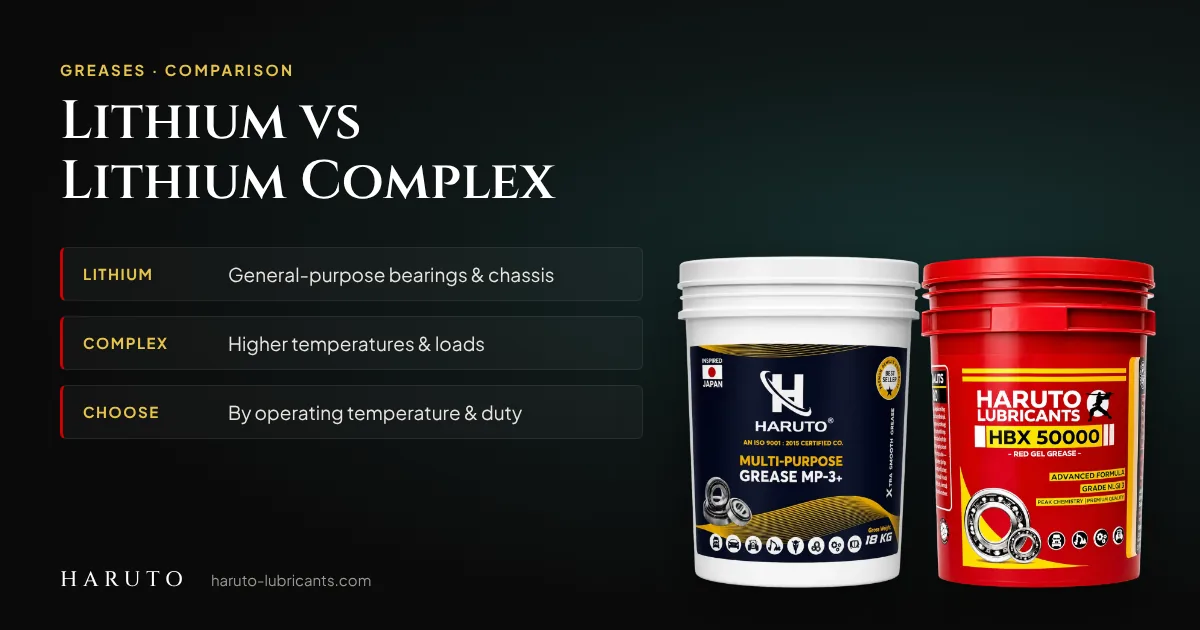
The quick answer
Standard lithium grease is an excellent, economical multipurpose grease for normal temperatures and loads. Lithium complex grease uses a more advanced soap structure that raises the dropping point well above 250°C and improves high-temperature life, load-carrying and water resistance — at a modest extra cost. If the application runs hot or heavily loaded, choose complex.
What is lithium grease?
Lithium grease uses a lithium soap (typically lithium 12-hydroxystearate) to thicken base oil. It offers good mechanical stability, water resistance and a useful temperature range, which is why it is the most widely used general-purpose grease in the world. Its dropping point — the temperature at which it passes from semi-solid to liquid — is usually around 180-200°C, giving a practical maximum operating temperature near 120-130°C.
What is lithium complex grease?
Lithium complex grease adds a complexing agent to the lithium soap, creating a structure that withstands much higher temperatures. The dropping point rises above 250°C, lifting the practical operating range and improving performance under load and in the presence of water. It is the natural upgrade where standard lithium grease is at its limits.
Dropping point is not an operating temperature
Lithium and lithium complex greases are usually compared by dropping point, and the number is often misread. The test heats a small sample in a cup until the first drop falls. It tells you where the thickener gives up — not the temperature at which the grease can work for months inside a bearing.
Long before a grease reaches its dropping point, heat is doing other damage:
- The base oil oxidises. Oxidation darkens and thickens the oil and eventually turns the grease into a hard, varnish-like crust.
- Oil bleeds out faster. The thickener releases oil more quickly when hot, so the grease dries out sooner.
- The grease softens. A grease that is firm on the workbench can slump and run out of a bearing at working temperature.
That is why the practical limit sits well below the dropping point. A widely used rule of thumb is that grease life roughly halves for every 10–15 °C a bearing runs above the grease’s comfortable range. A lithium grease that lasts well at 80 °C may need regreasing far more often at 110 °C, even though it is nowhere near its dropping point. Lithium complex earns its place by holding its structure and resisting oxidation better at those temperatures, not simply by having a bigger number on the data sheet.
Head-to-head comparison
| Property | Lithium | Lithium Complex |
|---|---|---|
| Dropping point | ~180-200°C | 260°C and above |
| Max operating temp | ~120-130°C | ~140-150°C+ |
| Load / EP capacity | Good (with EP additive) | Better |
| Water resistance | Good | Better |
| Mechanical stability | Good | Very good |
| Relative cost | Lower | Slightly higher |
| Best for | General bearings, normal temps | Hot, heavily loaded, wet |
Base oil viscosity: the other half of the decision
The thickener is only the sponge. Most of a grease — typically 70–90% by weight — is base oil, and it is the oil that forms the lubricating film between rolling elements and races. Two greases with the same thickener can behave very differently because of base oil viscosity.
| Operating condition | Base oil viscosity to look for | Why |
|---|---|---|
| High speed, light load (electric motors, fans) | Lower, around ISO VG 68–100 | Thin oil reaches the contact quickly and churns less heat |
| General bearings, moderate speed | Medium, around ISO VG 100–220 | The usual range for multipurpose lithium and lithium complex greases |
| Slow speed, heavy or shock load (pins, bushes, crushers, kiln rollers) | Higher, ISO VG 220–460 and above | A thicker film keeps surfaces apart under high contact pressure |
Engineers check this with the bearing’s speed factor — rpm multiplied by the bearing’s mean diameter in millimetres. The higher the speed factor, the thinner the base oil should be. You do not need to calculate it for every bearing, but the principle matters: a heavy-oil grease in a fast bearing runs hot, and a light-oil grease in a slow, loaded bearing lets metal touch metal. Read the base oil viscosity at 40 °C on the product data sheet alongside the thickener and NLGI grade.
EP, anti-wear and moly: what the additives add
Both lithium and lithium complex greases come in plain and EP (extreme-pressure) versions. The thickener decides temperature and structure; the additives decide how the grease behaves when the oil film is squeezed thin.
- EP additives react with hot metal surfaces at the points of highest load to form a protective layer that resists welding and scuffing. Look for them in shock-loaded, heavily loaded or slow bearings and in gear couplings. Data sheets usually express EP performance as a Timken OK load or a four-ball weld load — higher means more load-carrying capacity in that test.
- Anti-wear additives work at moderate loads to reduce gradual wear during normal running.
- Molybdenum disulphide (moly) is a dark grey solid lubricant. Its layered structure slides easily, so it keeps protecting surfaces even when the grease film breaks — useful on slow, heavily loaded or oscillating parts such as kingpins, spring pins, loader pins and splines. It adds little in high-speed rolling bearings.
- Rust and corrosion inhibitors matter wherever moisture can get in, which during an Indian monsoon means almost everywhere.
When you compare a lithium EP grease with a lithium complex grease, compare like with like: same NLGI grade, similar base oil viscosity, both EP. Otherwise you are comparing additive packages, not thickeners.
When to use each
- Choose standard lithium for general automotive and industrial bearings, electric tools, and anywhere temperatures and loads are moderate.
- Choose lithium complex for wheel bearings on heavy vehicles, hot industrial bearings, steel and cement plants, and applications exposed to water or shock load.
- Either works as a plant-wide multipurpose grease — many operations standardise on lithium complex to cover the widest range with one product.
Water, washout and the monsoon
Water damages grease in two ways. It physically washes grease out of bearings and joints, and water that stays inside emulsifies with the grease, softens it and lets rust start on rolling surfaces. Standard lithium grease has good water resistance; lithium complex generally holds its structure more firmly when water gets in.
Data sheets often report a water washout figure — the percentage of grease lost from a test bearing spun under a jet of hot water (ASTM D1264). Lower is better, so ask for it when comparing greases for wet duty.
- Monsoon-season vehicles — trucks, buses and tractors that wade through waterlogged roads and fields — benefit from lithium complex in wheel hubs and from regreasing chassis points to push water out.
- Paddy-field tractors and harvesters run with axles and pivots in mud and water for weeks; shorter regreasing intervals matter as much as the grease choice.
- Constant water or washdown — paper machine wet ends, steel plant roll necks, wash plants, marine equipment — is where calcium sulphonate grease typically outperforms both lithium types.
Signs that standard lithium has reached its limit
You do not need a laboratory to tell when a lithium grease is being asked to do too much. These are the common warning signs:
| What you see | What it usually means |
|---|---|
| Grease thinned and running out of seals or onto hub caps | Grease softening at working temperature |
| Dark brown or black, hard grease at the next service | Oxidation from sustained heat |
| Purged grease dry, crumbly or caked | Base oil bled out or burnt off; interval too long for the temperature |
| Milky, pale grease or rust marks | Water ingress and emulsification |
| Housing hotter than usual, or rising noise | Lubricant film breaking down; inspect the bearing |
| Regreasing needed far more often than the manual suggests | Grease past its comfortable temperature or load range |
If these appear on hot or loaded points, moving to lithium complex is usually the simplest fix, and it is generally compatible with the lithium grease already in place. If the problems are mainly water-related, look at calcium sulphonate. If the bearing is noisy or the races are marked, a grease change will not undo the damage — replace the bearing.
Regreasing intervals: what changes them
Switching to lithium complex often lets a site lengthen regreasing intervals, but the interval is never set by the grease alone. The equipment manual gives the starting point; these factors move it:
- Temperature. Hotter bearings need grease more often, for the oxidation reasons above.
- Speed. Faster bearings work the grease harder and typically need shorter intervals.
- Contamination. Dust in cement plants, crushers and quarries, or water in wet processes, means regreasing more often to flush contaminants out.
- Load and vibration. Shock loads and vibrating screens break the grease structure down faster.
- Orientation. Bearings on vertical shafts tend to lose grease faster than horizontal ones.
Start with the maker’s interval, then adjust on condition: the colour and texture of purged grease, housing temperature and noise. If you move from lithium to lithium complex, stretch intervals in small steps while watching the bearings, rather than doubling them on day one. Haruto supplies both Lithium MP (NLGI 2 and 3) and Lithium Complex (NLGI 1, 2 and 3) greases, so a site can step up without changing thickener family.