Types of Grease and Their Uses: Lithium, Complex, Calcium, Polyurea, EP, Moly and Graphite
“Grease” covers dozens of different products. A wheel-bearing grease, an electric-motor grease and an open-gear grease can look alike in the bucket and still behave completely differently in the machine. This guide sorts greases the way engineers do: first by thickener, then by additive. It ends with a simple table of which grease goes where.
What grease is made of
Every grease has three parts:
- Base oil (usually most of the grease). It does the actual lubricating. Its viscosity matters as much as the grease type.
- Thickener. A sponge-like structure that holds the oil in place and releases it slowly. The thickener gives a grease its name: lithium, calcium, polyurea and so on.
- Additives. Extreme-pressure (EP), anti-wear, rust inhibitors, solid lubricants such as moly or graphite, and tackifiers.
The thickener sets the temperature limit, water resistance and compatibility. The additives set load-carrying ability. The NLGI number (0, 1, 2, 3…) only tells you how stiff the grease is; see our NLGI grades guide.
Grease types by thickener
Temperatures below are typical for good-quality products; individual greases vary, so check the data sheet.
| Thickener | Typical max continuous use | Water resistance | Typical uses |
|---|---|---|---|
| Lithium | About 120 °C | Good | General-purpose: chassis, bearings, pins and bushes |
| Lithium complex | About 150 °C | Good to very good | Wheel bearings, hot-running bearings, heavy vehicles, plant |
| Calcium (hydrated) | About 60–80 °C | Excellent | Water pumps, wet low-temperature points |
| Calcium sulphonate complex | About 150–175 °C | Excellent | Wet, heavy-load plant: steel, paper, mining, marine |
| Aluminium complex | About 150 °C | Very good | Food and beverage machinery (food-grade versions), wet areas |
| Polyurea | About 150–175 °C | Good | Electric-motor bearings, sealed-for-life bearings, high speed |
| Clay (bentonite) | High, no melting point | Fair to good | Very hot, slow-moving parts: kiln and oven bearings |
| Sodium | About 100 °C | Poor (washes out) | Older, dry applications only |
“Dropping point” — the temperature at which a grease drips in a lab test — is always well above the safe operating temperature. A lithium grease with a dropping point near 190 °C should not run continuously anywhere near that. Our lithium vs lithium complex guide explains why.
Grease types by additive
EP grease
EP (extreme-pressure) additives protect metal surfaces under heavy or shock loads, when the oil film is squeezed thin. “EP2” on a bucket simply means an NLGI 2 grease with EP additives. Use EP grease for heavily loaded bearings, pins, bushes and slow gears. For a lightly loaded high-speed bearing, EP is not needed.
Moly grease (molybdenum disulphide)
Moly is a dark solid lubricant that stays on the surface when the oil film breaks down. It helps on slow, heavily loaded, oscillating or shock-loaded parts: excavator pins, kingpins, splines, CV joints, sliding plates. It is not normally used in high-speed rolling bearings or electric motors.
Graphite grease
Graphite is another solid lubricant, used for very hot or very slow parts, open gears, wire ropes and leaf springs. Like moly, keep it out of high-speed rolling bearings, where the solid particles do more harm than good.
Other special greases
- Copper and anti-seize pastes for bolts and threads that must come apart after heat.
- Silicone grease for rubber, plastics and seals under light load.
- PTFE greases for clean, low-friction sliding parts.
- Tacky “red gel” greases, often lithium or lithium complex with tackifiers, for water and vibration.
What people mean by “high-temperature grease”
There is no single “high-temp grease” type. A grease is good at high temperature when it has a heat-stable thickener (lithium complex, calcium sulphonate complex, polyurea or clay) and a base oil that resists oxidation. A simple lithium grease is a general-purpose grease, not a high-temperature one. For a bearing running hot all day, move to a complex grease and shorten the regreasing interval.
Which grease goes where
| Application | Usual choice | Usual NLGI |
|---|---|---|
| Vehicle wheel bearings | Lithium complex EP | 2 or 3 |
| Chassis points, pins and bushes | Lithium EP, often with moly | 2 |
| Excavator and loader pins | Lithium or lithium complex EP with moly | 2 |
| Electric-motor bearings | Polyurea or lithium, no solids | 2 or 3 |
| Centralised lubrication systems | Lithium or lithium complex EP | 00 to 1 |
| Wet, heavily loaded plant bearings | Calcium sulphonate complex | 2 |
| Very hot slow bearings | Clay or complex grease | 2 |
| Open gears, wire ropes | Graphite or open-gear compound | As per maker |
| Food and beverage machinery | Food-grade aluminium complex | 2 |
Can you mix grease types?
Often not. Some pairs (for example lithium and polyurea, or lithium and clay) can soften, bleed oil or harden when mixed. Before switching a machine to a different grease type, check our grease compatibility chart and purge the old grease properly.
How to choose: five questions
- How hot does the part run? Above about 120 °C continuous, move beyond simple lithium.
- How wet is it? Washdown, rain or process water point to calcium sulphonate or a tacky complex grease.
- How heavy or shock-loaded? Use EP; add moly for slow, oscillating parts.
- How fast? High-speed bearings need a lighter base oil and no solid additives.
- How is it applied? Grease guns usually take NLGI 2; centralised systems need softer grades.
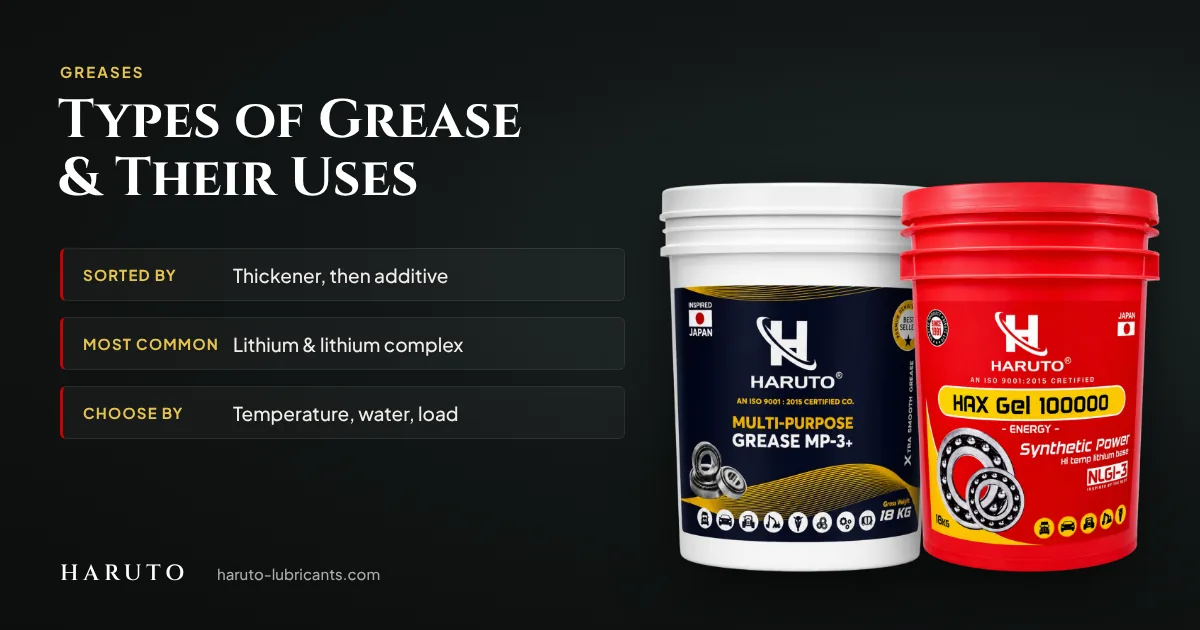
Haruto greases include MP-3+ (lithium multipurpose), HAX Gel 100000 (red high-temperature multipurpose), HBX 50000 (high-load bearing and chassis) and Chassis Pure (general-purpose chassis).