Engine Oil for Diesel Generators (Gensets): Grade, Change Interval and Care
A diesel generator looks like an easy job for engine oil: it runs at one speed, often under a roof. In practice gensets are hard on oil. Standby sets sit for weeks, then start cold and take full load at once. Lightly loaded sets build soot and fuel in the oil. Prime-power sets run for thousands of hours in hot enclosures. This guide covers which oil to use and how to look after it.
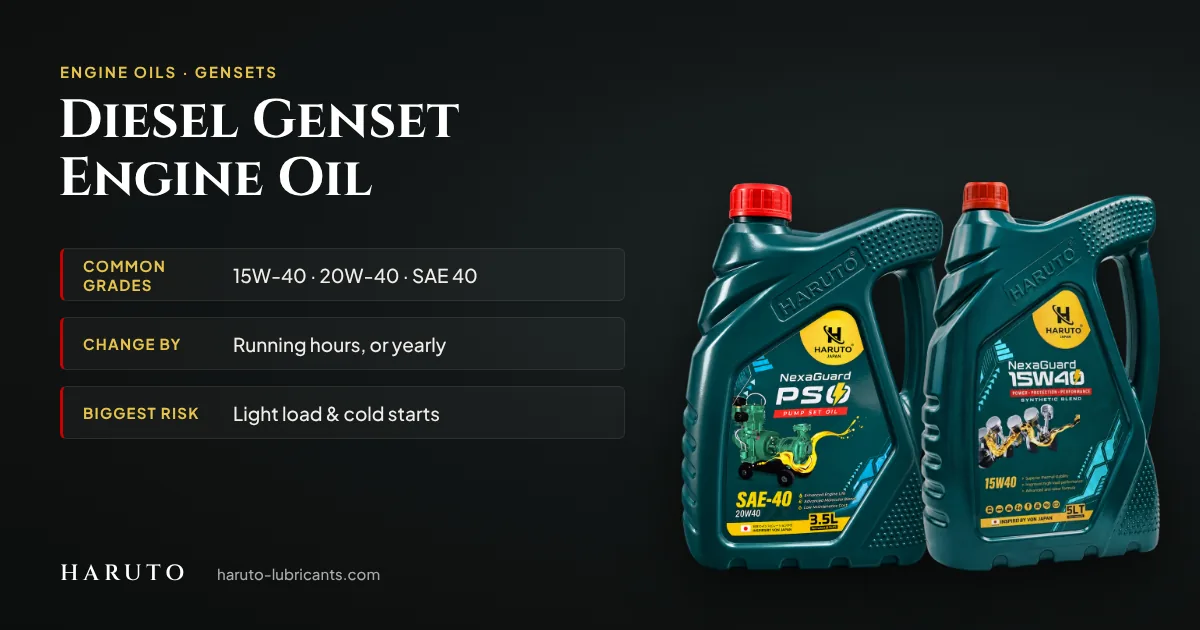
Why gensets are hard on engine oil
- Cold, dry starts. A standby set may sit for weeks. Oil drains off the bearings and cylinder walls, and the first seconds after start-up are nearly dry.
- Instant full load. When the mains fail, the set starts and takes load before the oil is warm.
- Light-load running. A set running at 10–30% load never gets hot enough. Fuel and soot build up in the oil, and unburnt fuel collects in the exhaust (“wet stacking”).
- Long hours in heat. Prime-power sets at factories, sites and telecom towers run for thousands of hours inside hot enclosures, which speeds up oil ageing.
- Dust. Sites, quarries and rural installations pull dust through tired air filters, and dust in oil means wear.
Which grade: 15W-40, 20W-40 or SAE 40?
| Grade | Where it fits | Notes |
|---|---|---|
| 15W-40 | Most modern diesel gensets; standby sets that start often | Fastest flow on start-up of the three. The usual default where the manual allows it. |
| 20W-40 | Older or high-hour sets in hot regions | Same protection as 15W-40 when hot; slightly slower when cold. |
| SAE 40 (straight grade) | Older slow-speed stationary engines and pump sets | Use only where the manual asks for it. Thickest at start-up. |
The engine manual decides. Look for two things in it: the viscosity grade and the performance level (diesel performance categories start with ‘C’). Match both. For the difference between the multigrades, see 15W-40 vs 20W-40 and 20W-40 engine oil uses.
How often should genset oil be changed?
Genset oil is changed by running hours, not kilometres. Many small and mid-size diesel sets call for an oil and filter change somewhere between 250 and 500 running hours; the exact figure is in your manual and depends on the engine and duty. Two rules apply on top of the hours:
- Change at least once a year, even if the set ran only a few hours. Oil ages in the sump, collects condensation and loses its additives over time.
- Shorten the interval for dusty sites, high ambient temperature, frequent light-load running or poor fuel.
| Duty | What to do |
|---|---|
| Standby, low hours | Change yearly; run monthly under load; check level before every test run |
| Prime power, steady load | Change at the manual’s hour interval; log oil top-ups daily |
| Light load most of the time | Shorter interval; add regular load-bank or real-load runs |
| Dusty or very hot site | Shorter interval; clean or change air filters more often |
Standby gensets: the monthly run
A standby set that only runs when the power fails is the one most likely to let you down. A simple monthly routine keeps the oil and engine ready:
- Check the oil and coolant levels with the set stopped and level.
- Start and run it under real load — ideally 30% or more of its rating — for 20 to 30 minutes, until it reaches normal temperature.
- Watch oil pressure and temperature, and look for leaks and smoke.
- Record the hours, any top-up and anything unusual.
Running a set for five minutes with no load does more harm than good: the oil never gets hot enough to drive off moisture and fuel.
Light load, wet stacking and black oil
Diesel engine oil turns black quickly because it holds soot in suspension. That is normal. What is not normal is oil that smells strongly of diesel, feels thin, or keeps rising on the dipstick. That points to fuel dilution, usually from long periods at very light load, worn injectors or repeated short runs. Fuel thins the oil, so the bearings lose protection. Fix the loading pattern or the injection, then change the oil.
Daily and periodic checks
- Daily (prime power) or before each run (standby): oil level, coolant level, leaks, air-filter indicator.
- Every oil change: new oil filter, a blotter spot test on the old oil, and a note of hours and top-ups.
- Large or critical sets: periodic oil analysis. The key lines are viscosity, soot, fuel dilution, water, silicon (dust) and wear metals.
Oil consumption: what is normal?
Every diesel burns a little oil. The figure to watch is the trend. Log every top-up against running hours. A steady figure is fine. A rising trend points to wear, a leak or oil that has thinned. If consumption suddenly jumps, find the cause before changing to a thicker grade.
Buying and storing genset oil
- Keep one grade and one brand for all your sets where the manuals allow it. It avoids mistakes and part-used packs.
- Store packs closed, under a roof, off the floor, away from the exhaust and the fuel tank.
- Keep a funnel and measuring jug used only for engine oil.
Haruto supplies NexaGuard engine oils in 15W-40 and 20W-40, and NexaGuard PSO pump set oil in SAE 40 and 20W-40, for gensets and pump sets.