20W-40 Engine Oil: Meaning, Uses and Which Vehicles Need It
20W-40 is one of the most common engine-oil grades sold in India. You will find it in tractor sheds, transport depots, genset rooms and roadside workshops. But many buyers are not sure what the numbers mean, or whether their engine should be on 20W-40, 15W-40 or a straight SAE 40. This guide explains the grade in plain words and shows where it fits.
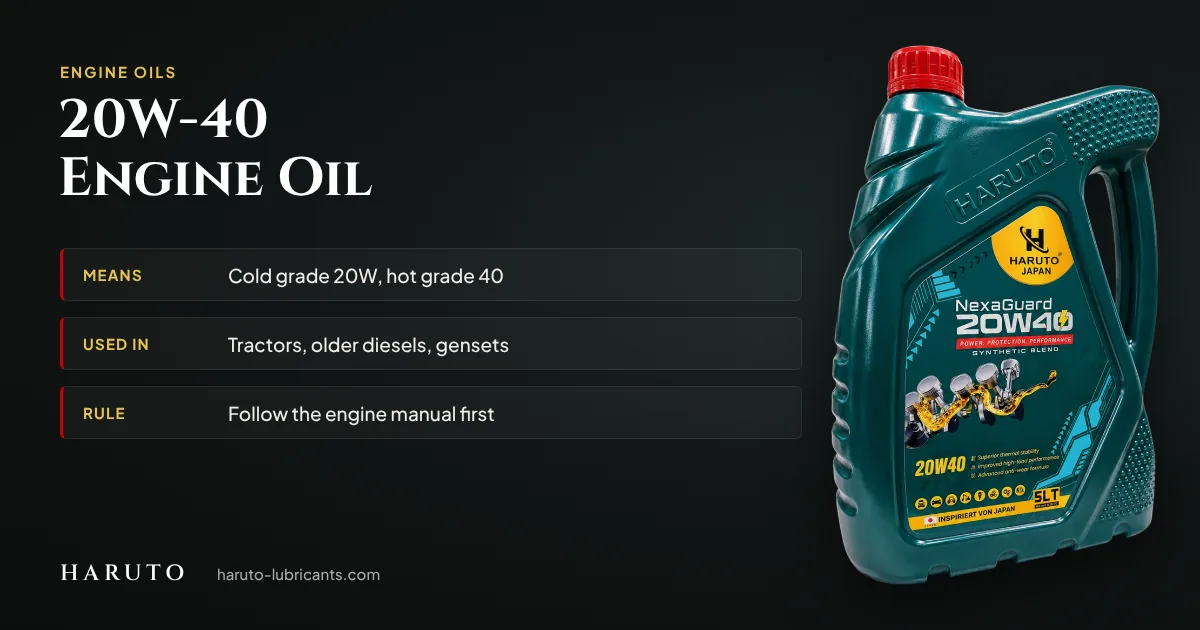
What does 20W-40 mean?
20W-40 is a multigrade engine oil. The two numbers come from the SAE J300 standard, which defines every engine-oil viscosity grade:
- 20W is the cold (“winter”) rating. It means the oil passed two cold tests: the starter can still crank the engine at −15 °C, and the oil pump can still pull the oil at −20 °C.
- 40 is the hot rating. At 100 °C, roughly normal engine temperature, the oil sits in the same viscosity band as any other ‘40’ oil (12.5 to below 16.3 cSt).
So a 20W-40 behaves like a thick oil when hot, yet still flows well enough to start an engine on a cool morning. That combination is why it suits so much of India’s older diesel equipment.
20W-40 at a glance
| Property | 20W-40 |
|---|---|
| Type | Multigrade (cold grade + hot grade) |
| Cold cranking limit (SAE J300) | Tested at −15 °C |
| Hot viscosity at 100 °C | 12.5 to below 16.3 cSt (same as every ‘40’ grade) |
| Typical users in India | Tractors, older trucks and buses, gensets, pump sets, stationary diesels |
| Usually not for | Modern low-viscosity car engines, engines whose manual asks for 5W-30, 10W-30 or 15W-40 only |
What is 20W-40 engine oil used for?
20W-40 is used wherever an engine maker lists it, most often in:
- Tractors. Many tractor manuals in India list 20W-40 or 15W-40 for the engine. It handles long hours at high load in heat and dust.
- Older and high-mileage diesel engines. Trucks, buses, pick-ups and LCVs with more internal clearance often run quieter and use less oil on 20W-40.
- Diesel gensets and pump sets. In hot regions, where cold starts are never truly cold, 20W-40 is a common choice for standby and prime-power engines. See our genset engine oil guide.
- Stationary and industrial diesels. Compressors, construction machines and older plant engines often specify it.
- Some older petrol engines. Older carburettor-era cars sometimes list 20W-40. Modern petrol cars almost never do.
20W-40 vs 15W-40 vs SAE 40
| 15W-40 | 20W-40 | SAE 40 (straight) | |
|---|---|---|---|
| Cold flow | Best of the three | Good | Thickest when cold |
| Hot protection | Same ‘40’ band | Same ‘40’ band | Same ‘40’ band |
| Typical fit | Modern diesels, cooler starts, frequent starts | Older diesels, tractors, hot regions | Old slow-speed stationary engines, where the manual asks for it |
When hot, all three protect alike. The difference is the first few minutes after a cold start, which is when most engine wear happens. That is why 15W-40 is the safer default for engines that start often, and why our 15W-40 vs 20W-40 guide goes deeper on that choice.
Is 20W-40 right for Indian weather?
For most of India, yes. Plains and coastal regions rarely see mornings below 5 °C, and 20W-40 cranks comfortably far below that. The places to think twice are hill routes and north Indian winters, where engines parked overnight can see near-freezing starts. There, 15W-40 (or whatever lower grade the manual allows) reaches the bearings sooner.
Heat is not a reason to move from 15W-40 to 20W-40. Both are ‘40’ when hot. What summer heat attacks is oil life (oxidation) and oil level, so keep the sump topped up and the radiator clean.
When 20W-40 is the wrong choice
- The manual lists only 15W-40, 10W-30 or a lower grade. Modern engines, especially newer emission-control engines, are designed around those oils.
- The engine sees regular near-freezing starts.
- The vehicle is a modern petrol car or a motorcycle (see the note above).
- You are trying to hide a worn engine’s oil consumption by going thicker. That only delays the repair.
Grade is only half the label
Viscosity tells you how thick the oil is. The performance level printed on the pack tells you what the additives are built to do: soot control, wear protection and deposit control. Diesel engines use performance categories that start with ‘C’ and petrol engines categories that start with ‘S’. Always match the performance level your manual asks for, as well as the grade. A correct-grade oil with an outdated performance level can still sludge a modern engine.
Top-ups, mixing and drain intervals
- Topping up with 15W-40 in an engine filled with 20W-40 is fine in an emergency. Both are ‘40’ when hot.
- Drain intervals are set by the engine maker for the duty, not by the grade. Dusty roads, overloading, long idling and short trips all count as severe service and shorten the interval.
- Do not switch grades every change. Pick the grade the manual allows and stay with it, so your oil-consumption records stay comparable.
Quick buying checklist
- Check the manual: is 20W-40 listed for your engine and climate?
- Match the performance level printed in the manual.
- Buy pack sizes to suit the job: small packs for top-ups, larger packs for full changes at a workshop or farm.
- Store packs closed, under a roof and off the ground.
- Note the date and hours at each change.
Haruto NexaGuard engine oils come in 15W-40 and 20W-40, from 500 ml and 1 L top-up packs to bulk packs for workshops and fleets.