Private-Label & Third-Party Lubricant Manufacturing in India
Building your own lubricant brand no longer means building a blending plant. Through private-label (third-party) manufacturing, a distributor, retailer or new brand can sell professionally-blended oils and greases under its own label — while an established manufacturer handles the formulation, blending, testing and packaging. Here is how it works in India and how to start.
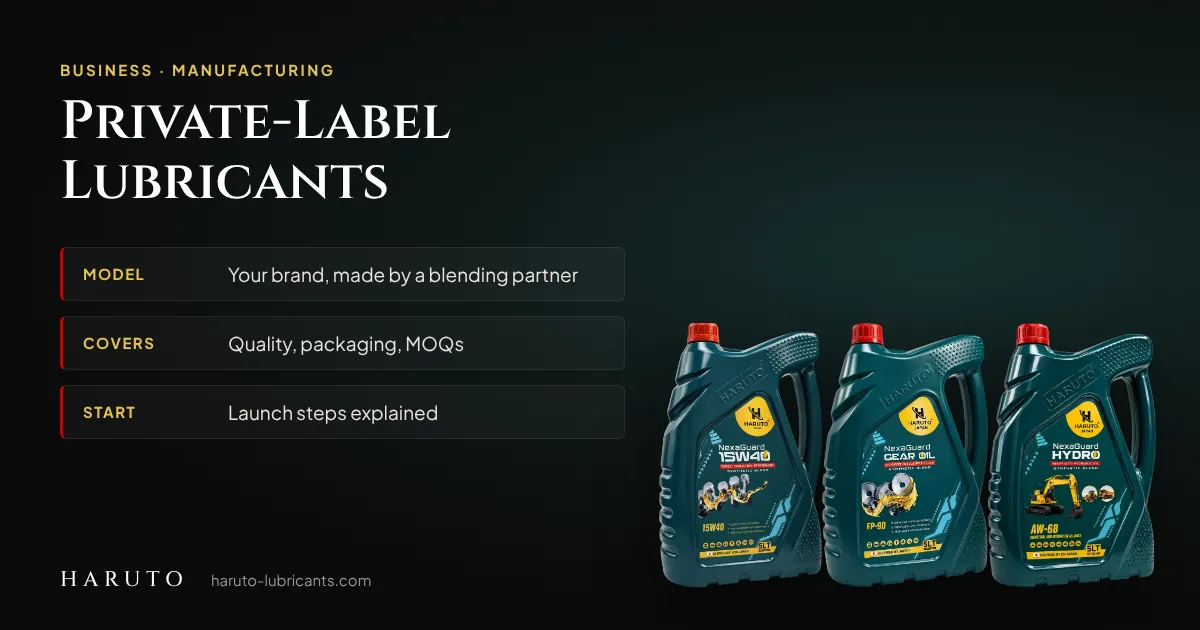
What private-label manufacturing means
In a private-label arrangement, the manufacturer produces lubricants to agreed specifications and fills them into your branded packaging. You own the brand, the label and the customer relationship; the manufacturer supplies the product, the quality control and often the technical data sheets. It is also called third-party or contract manufacturing.
Who it suits
- Distributors who want their own margin-rich house brand alongside the brands they carry
- Retail chains and workshops building customer loyalty around a private label
- Exporters and new entrants who want to launch quickly without capital-heavy plant
How the formulation is agreed
Before any blending, agree in writing what each product is. A vague brief such as “a good 15W-40” produces samples that cannot be compared and complaints that cannot be traced. A useful specification covers five points per product.
| Decision | What to specify | Example |
|---|---|---|
| Application | The equipment and duty the product is for | Diesel trucks and tractors on long, hot duty cycles |
| Viscosity grade | SAE grade for engine and gear oils, ISO VG for industrial oils, NLGI grade for greases | SAE 15W-40; ISO VG 68; NLGI 2 |
| Performance level | The API, JASO or ISO category the product must meet | API CI-4 diesel oil; GL-5 axle oil; ISO 11158 HM hydraulic oil |
| Base oil type | Mineral, semi-synthetic or synthetic | Mineral for a value line, synthetic for a premium line |
| Typical properties | The ranges every batch will be checked against | Viscosity at 40 °C and 100 °C, flash point, pour point |
If you are unsure which performance level your market expects, our guides to API CI-4, CH-4 and CK-4 and NLGI grease grades are a sensible starting point.
Sampling and approval
The manufacturer then blends a sample. Test it — at an independent lab for anything critical — and run it in equipment your customers use: a workshop’s trucks, a tractor through a season, a press on a hot shop floor. On approval, sign and date the sample, keep part of it sealed and record the approved values. That sealed sample is the reference every future batch is compared against.
What a good manufacturing partner provides
- In-house formulation and blending across engine, gear, hydraulic and grease lines
- A testing lab and adherence to API, SAE, ASTM and NLGI standards
- Flexible packaging and pack sizes with your artwork
- Reasonable minimum order quantities (MOQs) and reliable lead times
- Documentation — product data sheets and batch quality records
How to evaluate a manufacturing partner
Every manufacturer says its quality is good. Visit the plant and check — these points separate a dependable blender from a trader who outsources the work.
| Check | What to look for | Question to ask |
|---|---|---|
| Blending capacity | Heated, stirred blending vessels sized for your volumes alongside existing customers | How are my orders scheduled in your busiest months? |
| In-house lab | At minimum viscosity, flash point, density and water checks; penetration and dropping-point equipment for greases | Which tests run on every batch, and which only periodically? |
| Batch consistency | Records kept for each product over months, not just the latest batch | Can I see results for the last several batches of a similar grade? |
| Raw materials | Base oils and additives from consistent sources, checked on arrival | What happens if you change a base oil or additive supplier? |
| Storage and filling | Covered tanks; filling lines flushed or dedicated between products | How do you stop one product contaminating the next? |
| Retained samples | A sample from every batch kept for a defined period | How long are retained samples kept, and can I have one on request? |
Ask to speak to an existing private-label customer. How a manufacturer handled a complaint tells you more than its brochure.
Data sheets and batch documentation
Industrial buyers and fleet engineers will ask for paperwork. Agree its format before the first order.
Product data sheet (PDS)
One per product, issued under your brand. A complete PDS includes:
- Product name, description and recommended applications
- Viscosity grade and the performance level claimed
- Typical properties: kinematic viscosity at 40 °C and 100 °C, viscosity index, flash point, pour point and density; TBN for engine oils; NLGI grade, worked penetration, dropping point and base oil viscosity for greases
- Available pack sizes
Also get a safety data sheet (SDS) for every product; many factories will not admit a new oil without one.
Batch documentation
Each batch should carry a batch number on the pack and a batch analysis report showing its actual results against the approved range. The batch number on the pack, invoice and report must match, so a complaint can be traced to one batch instead of pulling back everything.
Quality checks to insist on
- Every batch tested against the approved range before dispatch, not after
- Fill quantity checked — short-filled packs cause trouble with customers and under packaged-goods rules
- Caps and seals checked for leaks on long summer truck journeys
- Retained samples on both sides, plus occasional independent tests of batches you pick
Private label vs your own plant
| Factor | Private label | Own plant |
|---|---|---|
| Upfront investment | Low — product + packaging | Very high — land, plant, licences |
| Time to market | Fast | Slow |
| Quality control | Handled by the manufacturer | Your responsibility |
| Branding & margin | Your brand, your margin | Your brand, your margin |
Packaging choices and label content
Pack sizes should follow how your customers buy. Too many sizes multiplies printed packaging stock and slows every order.
| Pack type | Typical buyer | What to check |
|---|---|---|
| Small bottles | Retail counters, car and motorcycle owners | Cap seal, pouring spout, a label that survives oily hands |
| Cans and buckets | Workshops, tractor owners, small plants | Handle strength, lid fit, stacking strength in summer heat |
| Pails and drums | Fleets, factories, bulk users | Lid and bung seals, drum quality, marking that survives outdoor storage |
| Grease packs | Workshops and maintenance teams | Tubes, jars or buckets with lids tight enough to keep dust and water out |
What must appear on the label
Retail packs of lubricants sold in India must carry the declarations required under the Legal Metrology (Packaged Commodities) Rules. Large packs and supplies to industrial or institutional buyers are treated differently, so confirm which rules apply to each pack size with a Legal Metrology consultant or your CA. In general terms the retail declarations include:
- Name and address of the manufacturer, and of the packer or marketer where different — private-label packs commonly read “Manufactured by … Marketed by …”
- Common or generic name of the product
- Net quantity in standard units — millilitres or litres for oils, grams or kilograms for greases
- Month and year of manufacture
- The retail sale price declaration
- Consumer care details, such as a phone number and email address
Add the batch number, grade and brief safety text. The rules are amended from time to time, so have final artwork checked against the current version. With plastic bottles or pails, also check your obligations as a brand owner under the Extended Producer Responsibility (EPR) framework for plastic packaging, and ask your CA or an EPR consultant whether the separate EPR rules for used oil apply to your brand.
Brand ownership and the agreement
Settle these before you print a single label — easy to agree now, painful to argue later.
- Trademark. Search the trademark registry for your brand name before paying for artwork, and file an application in your own company’s name. Lubricants fall under Class 4 of the international classification India follows.
- Artwork. The designs and print files should belong to you.
- Formulation. This usually remains the manufacturer’s know-how. If you move, you keep the brand and approved specification; the new partner matches the specification, not the old recipe.
- Confidentiality. Your brand, customer details and artwork are not shared.
- Printed packaging stock. Decide who carries leftover labels and printed containers if a design changes or the relationship ends.
- Complaints. Write down who investigates a complaint, how retained samples are used, and who bears the cost if a batch is found outside the approved range.
How to launch your brand
- Pick your range — the grades your customers actually buy (start focused).
- Choose a partner with the right certifications, MOQs and support.
- Design your label and finalise pack sizes.
- Approve samples, confirm specifications and data sheets.
- Place the first order and build your distribution.
Planning the first order and reorders
Stock planning decides whether a new brand runs out in its first busy season or sits on slow packs for a year.
- Size the first order from real demand. Start from orders your buyers have already promised, plus the sales you can reasonably expect before a second batch could arrive — not from the minimum order quantity alone.
- Order packaging first. Printed bottles, labels and drums can take longer than blending. Ask for the lead time on each separately.
- Plan around the seasons. Tractor engine oil, transmission oil and grease move ahead of kharif and rabi work. Place those orders well before the rush, when blending slots are easier to get.
- Set a reorder point for each item. Reorder when stock falls to the sales you expect during the full lead time, plus a buffer for a late batch.
- Review every month. Track sales by grade and pack size, drop items that do not move, and sell the oldest stock first using the month of manufacture on the label.
Common mistakes when launching a private label
- Launching too wide. Twenty grades in five pack sizes is a hundred items to stock and print. Start with what already sells — often a diesel engine oil, gear oil, hydraulic oil and grease.
- Choosing on cost alone. A cheaper blend means little if batches vary.
- Weak specifications. Without property ranges, you cannot reject a bad batch.
- Skipping field trials. Lab results do not show how an oil behaves in an overloaded tipper in May or a dusty tractor at harvest. Put samples in real equipment first.
- Leaving paperwork to the end. Missing label declarations, trademark or EPR registration can stall a launch after stock is made.
- No plan to sell. Line up the buyers for the first batch before you order it.
Weighing your own label against carrying an established range? Our distributorship guide covers the other side, and you can discuss either route via our private-label enquiry page.