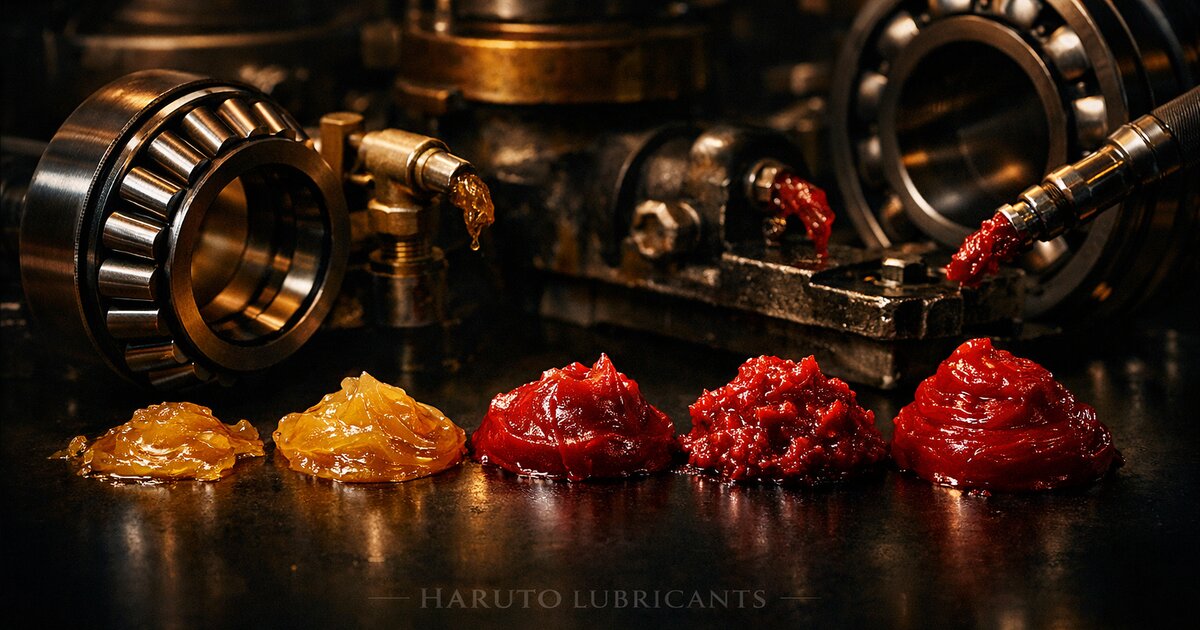
What Is NLGI Grade?
NLGI stands for the National Lubricating Grease Institute, the body that established the standard consistency classification for greases. The scale runs from NLGI 000 (almost fluid) to NLGI 6 (very hard, brick-like). In industrial and automotive practice, grades 0 through 3 cover the vast majority of applications.
Consistency is measured by the worked penetration test — a standardised cone is dropped into the grease and the depth of penetration (in tenths of a millimetre) is recorded. A higher penetration value means softer grease; a lower value means firmer. Each NLGI grade corresponds to a defined penetration range.
Simple analogy: Think of NLGI grades like butter. NLGI 00 is like cooking oil — almost pourable. NLGI 1 is like cold butter — soft but holds shape. NLGI 2 is like refrigerated butter — firm. NLGI 3 is like a hard cheese — stiff and stays put. Each has its place.
The Common Grades and Their Applications
| NLGI Grade | Texture | Typical Application | Operating Temp |
|---|---|---|---|
| 00 / 0 | Semi-fluid | Centralized lube systems, gear housings, worm gears | -30°C to +120°C |
| 1 | Soft | Slow-speed bearings, cold climate applications, large bearings | -20°C to +130°C |
| 2 | Medium | General-purpose bearings, automotive wheel bearings, electric motors | -20°C to +140°C |
| 3 | Firm | High-speed spindles, vertical shaft bearings, extreme vibration | -10°C to +150°C |
NLGI 0 — Centralised Lube Systems and Gear Housings
Semi-fluid greases at NLGI 0 are used where oil would splash or escape but a pumpable lubricant is still required. Common applications include centralised automatic lubrication systems that feed multiple bearing points through small-diameter feed lines, and enclosed gear housings where the grease acts more like a very heavy oil, coating the gear faces as they rotate. These greases flow readily even at low temperatures, making them suitable for equipment in cold environments.
NLGI 1 — Large and Slow Bearings
Softer than the standard general-purpose grade, NLGI 1 is well-suited for large diameter bearings, slow-speed applications, and cold-climate machinery. The lower consistency ensures the grease flows into the bearing contact zone even when the rolling elements are moving slowly — an important factor where churning and heat generation are minimal. Agricultural equipment operating in winter conditions, and some paper mill roll bearings, commonly specify NLGI 1.
NLGI 2 — The Industry Standard
If there is a single "default" grease grade, it is NLGI 2. The majority of automotive wheel bearings, industrial ball and roller bearings, electric motor bearings, and general plant machinery call for NLGI 2. It provides the best balance of pumpability, retention in the bearing housing, and film strength across a wide temperature range. The Haruto Sigma EP2 is formulated to NLGI 2 consistency with an extreme-pressure additive package suitable for both automotive and industrial applications.
NLGI 3 — High Speed and Vertical Shafts
Where centrifugal forces, vibration, or gravity would cause a softer grease to migrate out of the bearing, NLGI 3 provides the firmness needed to stay in place. Common uses include high-speed spindle bearings, vertical shaft arrangements, and heavily vibrating equipment. The firmer consistency resists being flung out at high RPM, maintaining a consistent lubricating film at the contact zone.
What Else Determines Grease Performance?
NLGI grade only describes consistency — it says nothing about the base oil viscosity, the thickener type, or the additive package. Two greases can share the same NLGI grade and perform very differently.
Base oil viscosity determines the film thickness at the bearing surface. High-speed, lightly-loaded bearings need a low base oil viscosity; slow, heavily-loaded bearings need a higher one. Thickener type — lithium, calcium, polyurea, or lithium complex — affects water resistance, temperature range, and compatibility. Many greases use lithium or lithium complex thickeners for general use, while polyurea is common in sealed-for-life electric motor bearings.
Extreme-pressure (EP) additives matter in applications with shock loading, gear tooth contact, or high surface pressures. A standard NLGI 2 multipurpose grease and an NLGI 2 EP grease carry the same grade but the EP version is necessary in applications like universal joints, chassis points, and wheel hub bearings under heavy load.
Grease compatibility warning: Not all greases mix safely. Combining incompatible thickener systems — for example, lithium and calcium — can cause the mixture to soften dramatically and lose its ability to stay in the bearing. Always confirm thickener compatibility before switching grease suppliers, or purge the old grease thoroughly before regreasing with a different formulation.
How to Select the Right Grade
Start with the OEM specification. Equipment manufacturers specify grease type, NLGI grade, and often the base oil viscosity required. This is the most reliable starting point and deviating from it — particularly going to a softer grade in a high-speed application — can lead to grease migration, overheating, and premature bearing failure.
Consider operating temperature. In cold climates or cold-start conditions, a softer grade (NLGI 1) ensures the grease flows to the bearing surface before heat builds up. In high-temperature applications — around foundry equipment, kilns, or autoclaves — a firmer grade with a high-temperature thickener may be needed to prevent the grease from softening and being expelled.
Consider shaft orientation and speed. Vertical shafts, high RPM applications, and heavily vibrating machinery all favour firmer grades (NLGI 2–3) to prevent grease from migrating away from the bearing contact zone under centrifugal or gravitational force.