What "Quality" Actually Means in a Lubricant
Two engine oils can carry the same viscosity grade label — 15W-40, for example — and appear identical in a drum. The difference lies in what is not visible: the additive package, the base oil quality, and the consistency of formulation.
Premium lubricants are formulated with Group II or Group III mineral base oils (or full synthetic Group IV PAO), which have lower sulphur content, better oxidation resistance, and more consistent molecular structure compared to Group I base stocks. A cheaper product may use Group I base oils that oxidise faster, produce more sludge, and thin out more rapidly at high temperatures.
The additive package is where the real cost difference lives. Anti-wear additives (ZDDP and its alternatives), detergents, dispersants, antioxidants, corrosion inhibitors, and viscosity index improvers are expensive to formulate well. Reducing their concentration — or using lower-quality versions — cuts the manufacturing cost significantly, but the protection delivered to metal surfaces is measurably inferior.
Oxidation and Sludge
All lubricants oxidise over time and under heat. The rate of oxidation determines how quickly the oil degrades, thickens, and begins depositing sludge and varnish on internal surfaces. A premium lubricant with strong antioxidant chemistry can maintain its protective properties through a 500-hour drain interval; a budget formulation may degrade significantly by 200 hours, leaving acidic oxidation products in contact with metal surfaces and depositing varnish on pistons, valve trains, and hydraulic valve spools.
This varnish is not merely cosmetic. On hydraulic valves, varnish deposits cause spool sticking and erratic control. On engine pistons, it restricts ring movement and increases oil consumption. In turbine systems, varnish on governor valves affects speed regulation reliability.
Anti-Wear Film Strength
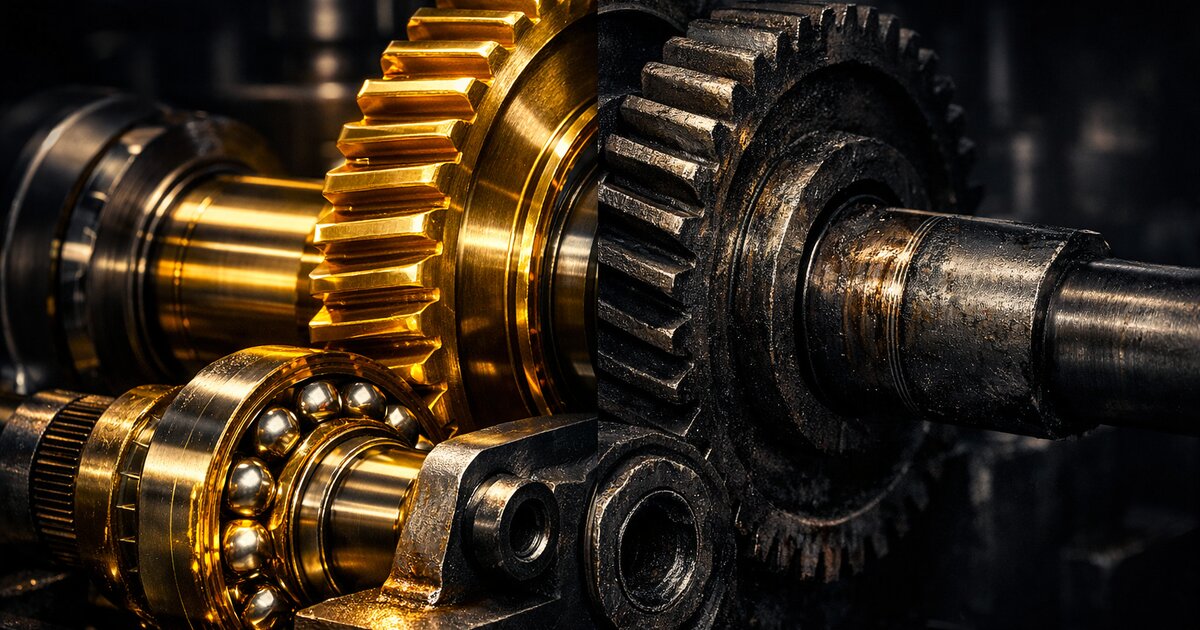
In boundary lubrication conditions — where surfaces come under such load that the oil film between them becomes extremely thin — anti-wear additives are the last line of defence. They chemically react with the metal surface under pressure and temperature to form a sacrificial protective film (a process called tribochemical film formation). If this additive is underdosed or of poor quality, the protective reaction does not occur at the required rate, and metal-to-metal contact results in accelerated wear.
This is directly observable in wear particle analysis. Oil samples taken from systems running premium vs. substandard lubricants of the same grade show consistently different ferrous particle counts at equivalent operating hours — a direct indicator of the rate at which internal metal components are being worn away.
Fleet operator insight: Several commercial fleet operators running mixed lubricant trials — premium on half the vehicles, budget on the other — found that at 100,000 km, the budget-lubricated engines showed 30–45% higher cylinder wear and significantly higher valve train wear on teardown inspection. The saving per change was ₹400–600 per vehicle. The resulting earlier overhaul cost was in the tens of thousands.
The True Cost Calculation
Lubricant selection should be evaluated as a total cost of ownership (TCO) decision, not a price-per-litre decision. The relevant variables are drain interval (how frequently the oil must be changed), component replacement interval (how long bearings, pumps, and engine components last), unplanned downtime cost (production stoppages caused by premature failures), and energy consumption (a well-lubricated system with lower friction uses measurably less power).
When these factors are included, the premium product almost always delivers a lower total cost. A lubricant that is 25% more expensive per litre but allows a 40% longer drain interval is already cost-neutral on the consumable alone — before the wear reduction benefits are counted. Adding extended component life and reduced downtime, the economics consistently favour quality.
Drain Interval Extension
One of the most direct ways lubricant quality affects operating cost is through drain interval. Premium lubricants with strong oxidation resistance and robust additive packages maintain their performance across longer intervals — sometimes double or more compared to economy products. Extended drain intervals mean less labour, less waste oil disposal cost, and less downtime for oil changes. For a large fleet or a continuous-process plant, the labour and downtime savings alone can justify the difference in product cost.
Contamination Control
Premium lubricants also typically contain better dispersant chemistry — additives that hold combustion by-products, wear particles, and moisture in suspension so they can be removed by the filter rather than depositing on surfaces. A lubricant that does not disperse contaminants effectively allows particles to agglomerate, creating abrasive clusters that accelerate wear rates beyond what either the particles or the lubricant degradation alone would cause.
Identifying Quality Before Purchase
When evaluating lubricants, look beyond the price and grade label. Request a Product Data Sheet (PDS) and confirm the base oil type (Group II or better for most applications), the API or ACEA performance category, and whether the product meets the relevant OEM approvals for your equipment. For engine oils, API SN/SP or CK-4 approvals and OEM approvals from manufacturers like Mercedes, Volvo, or Cummins require extensive third-party testing that budget products typically do not pass or do not bother certifying for. For hydraulic oils, DIN 51524 Part 2 HLP is the benchmark.
If the supplier cannot provide a PDS, or if the PDS lists no industry approvals, that absence is itself informative. Reputable lubricant manufacturers invest in testing and certification precisely because it provides verifiable evidence of performance — evidence that makes the product defensible in procurement decisions and technical conversations.