Mineral vs Semi-Synthetic vs Synthetic Engine Oil
Every engine oil is built on a base oil, and the type of base oil is what separates mineral, semi-synthetic and fully synthetic. It affects how well the oil protects, how long it lasts, and how much it costs. Here is the difference in plain terms and how to choose.
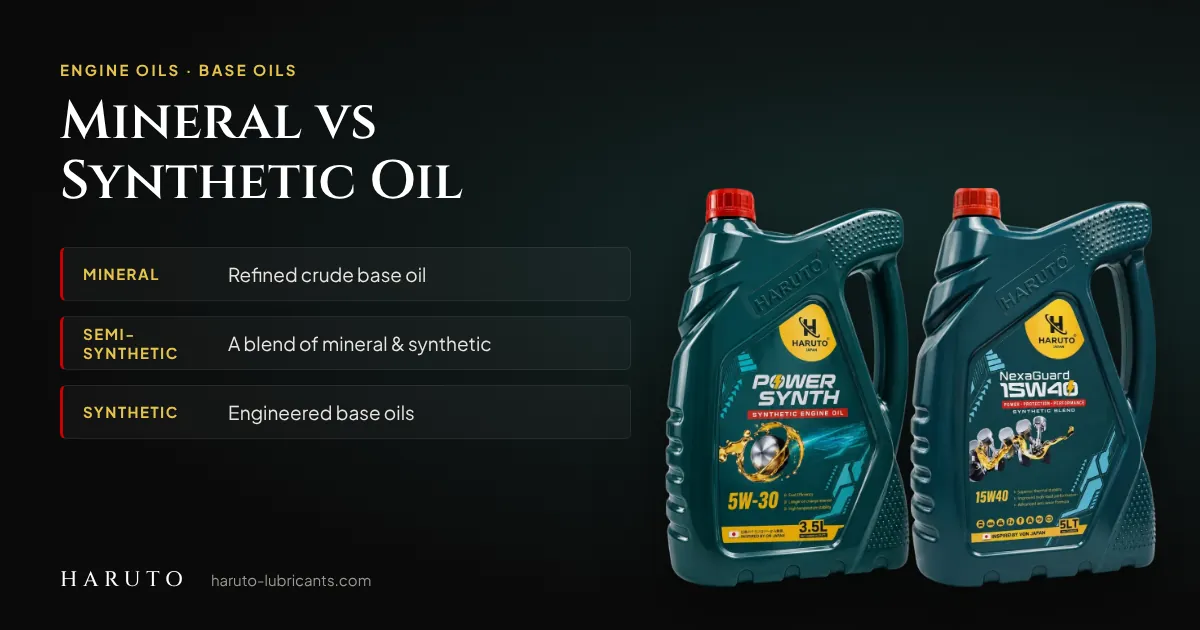
What the three types actually are
Mineral oil is refined directly from crude. It protects well and is the most affordable, but it breaks down sooner and flows less easily when cold. Fully synthetic oil is engineered in a lab for uniform molecules — it handles heat, cold and long drain intervals far better. Semi-synthetic (synthetic blend) mixes the two for a middle ground on both performance and price.
| Mineral | Semi-Synthetic | Fully Synthetic | |
|---|---|---|---|
| Protection | Good | Better | Best |
| Drain interval | Shortest | Medium | Longest |
| Cold-start flow | Weakest | Good | Excellent |
| Cost | Lowest | Medium | Highest |
| Best for | Older / simple engines, short trips | Most modern cars & fleets | Turbo, high-performance, extreme conditions |
Base oil groups I to V, in plain terms
The words mineral and synthetic are marketing shorthand. Refiners and formulators use the API base oil groups, which sort base oils by how they are made and by three measured properties: saturates (how stable the molecules are), sulphur content and viscosity index (how little the oil thins as it heats up).
| Group | How it is made | Key properties | Where you meet it |
|---|---|---|---|
| Group I | Solvent-refined from crude | Saturates below 90% and/or sulphur above 0.03%, VI 80 to below 120 | Older mineral engine oils, many industrial oils |
| Group II | Hydroprocessed (hydrotreated) crude | Saturates 90% or more, sulphur 0.03% or less, VI 80–120 | Most modern mineral engine oils |
| Group III | Severely hydrocracked crude | Same purity as Group II, VI 120 or higher | Most oils sold as ‘synthetic’ or used in blends |
| Group IV | Synthesised polyalphaolefin (PAO) | Very high VI, excellent cold flow and heat stability | Premium full synthetics |
| Group V | Everything else — esters, other synthetics | Chosen for specific properties | Blended in small amounts for seals, solvency or extreme duty |
The important point for a buyer: Group III starts as crude but is refined so heavily that its molecules behave much like a synthetic, which is why oils built on it are widely labelled synthetic. Group IV PAO is built up molecule by molecule. Both outperform Group I and II on heat, cold flow and volatility, and Group IV goes furthest. A ‘mineral’ oil today is usually Group I or II.
What ‘synthetic blend’ really means on a label
There is no industry-wide rule for how much synthetic base oil a semi-synthetic must contain. One blend may carry a large share of Group III or PAO; another may carry very little. So the words on the front of the pack tell you less than the numbers on the data sheet. When you compare two oils, ask for the product data sheet and look at:
- SAE grade and API category — these must match your manual before anything else matters.
- Viscosity index (VI) — higher means the oil holds its thickness better from a cold start to full heat. It is one of the clearest signs of better base oil.
- Pour point — the lowest temperature at which the oil still flows. Lower is better for cold starts.
- Volatility (Noack) and flash point — lower volatility and a higher flash point mean less oil boils off in a hot engine, which helps oil consumption in Indian summers.
- Kinematic viscosity at 100 °C — it should sit within the SAE band for the hot grade.
Which should you use?
Match the oil to the engine and how it is driven. An older or simple engine that specifies a mineral grade runs perfectly well on quality mineral oil. Most modern cars, tractors and fleets do well on a semi-synthetic — a real step up in protection without the full-synthetic price. Turbocharged, high-performance or hard-worked engines — and anything the manufacturer specifies synthetic for — should use fully synthetic.
How Indian operating conditions change the answer
The case for a better base oil depends less on the vehicle badge and more on how hard the oil is worked. Indian duty adds stresses that brochures written for cooler countries do not always cover:
- Heat. Summer ambient above 40 °C, slow traffic and dusty radiators push oil temperatures up. Heat speeds up oxidation, and oxidised oil thickens and forms deposits. Higher-group base oils resist this longer.
- Turbochargers. A turbo bearing runs very hot, and a hot shutdown can cook the oil left inside it. Turbo diesels and petrol turbo cars gain most from synthetic or a strong blend.
- Stop-start city work. Short trips mean many cold starts and an engine that rarely reaches full temperature, so moisture and fuel collect in the oil. Better cold flow helps, but a shorter drain helps more.
- Dust and overloading. These wear an engine regardless of base oil. A synthetic will not make up for a poor air filter or an overloaded tipper.
- Old, simple engines. An older tractor, pump set or genset that specifies a mineral 15W-40 or 20W-40 and gets frequent oil changes gains little from a synthetic.
In short: spend on base oil where heat, turbos and long intervals are the issue; spend on air filters, correct loading and on-time changes where dust and abuse are the issue.
Drain intervals and what to check in service
Synthetic base oil resists oxidation and thermal breakdown, which is why it can support longer drains. But oil also wears out in ways base oil cannot prevent: soot builds up, the detergent additives that neutralise acids are used up, dust gets past the filter and fuel leaks into the sump. That is why the drain interval comes from the engine manual and your duty cycle, not from the word ‘synthetic’ on the pack. Do not extend drains just because you switched to a synthetic; extend only if the manual allows it and oil analysis confirms the oil is still healthy.
Simple checks tell you a lot between services:
- Dipstick. Black diesel oil is normal. Milky oil (water or coolant), a fuel smell or a gritty feel is not.
- Blotter spot. A drop of warm oil on white filter paper should spread evenly. A dense black centre with a sharp edge means the oil can no longer hold soot and is due for a change.
- Consumption log. Record every top-up. A sudden rise after switching base type points to a seal or wear issue, not to the oil being ‘wrong’.
On fleets and high-value engines, a lab report adds viscosity at 100 °C, soot, fuel dilution, water, silicon (dust), wear metals and remaining base number — the data you need to set drains with confidence.
Can you switch between them?
Yes — switching from mineral to synthetic (or back) does not harm a healthy engine, and modern oils are compatible when you top up. Very high-mileage engines used to a thick mineral oil are the only ones to watch, as a thinner synthetic can reveal existing seal seepage. When in doubt, follow the owner’s manual.
Running a fair trial before switching a fleet
For a fleet, test a change of base oil on a few vehicles before switching every engine.
- Pick two or three vehicles on the same route and duty, and keep similar vehicles on the current oil for comparison.
- Change the oil and filter at the start, so the trial oil is not diluted by the old one.
- Keep the normal drain interval during the trial; do not extend it yet.
- Log top-ups, fuel use and driver complaints, and take oil samples at mid-interval and at the drain from both groups.
- Compare viscosity, soot, wear metals and remaining base number before deciding.
If the trial oil shows no clear benefit for your duty, the simpler, lower-cost option is the right one.
Common mistakes when choosing by base oil
- Buying the base oil and forgetting the grade. A synthetic 5W-30 in an engine that specifies 15W-40 is the wrong oil, however premium it is.
- Assuming mineral means poor quality. A good mineral oil at the right API category is the correct choice for many tractors, gensets and older trucks.
- Stretching drains on faith. Long intervals need the manual’s approval and oil analysis, not a label.
- Judging oil by colour or feel alone. Thin-feeling oil can still be a 40 grade when hot; dark oil can still be working perfectly.
- Paying for a blend without a data sheet. If a supplier cannot show the VI, pour point and API category, you cannot compare the oil fairly.
Decision checklist: which base type for which job
| Engine and duty | Typical sensible choice | Why |
|---|---|---|
| Older tractor, pump set or genset, frequent changes | Quality mineral | Designed for it; short drains limit oxidation |
| Modern diesel truck, bus or LCV on normal drains | Mineral or semi-synthetic to manual spec | Grade and API category matter more than base type |
| Turbo car or SUV, hot city traffic | Semi-synthetic or synthetic | Turbo heat and stop-start running |
| Engine whose manual specifies 0W or 5W grades | Synthetic as specified | Low W grades generally need high-VI base oils |
| Fleet aiming to extend drains | Synthetic plus oil analysis | Base oil enables it; analysis proves it |
- Find the viscosity grade and API category in the manual.
- Note whether the manual requires a synthetic or a specific low-W grade.
- Weigh your duty: heat, turbo, stop-start, drain length.
- Compare data sheets on VI, pour point and volatility, not on the label wording.
- Set the drain from the manual’s normal or severe-service interval and check it with field tests.
The Haruto NexaGuard engine oil range runs from 0W-30 and 5W-30 for modern petrol engines to 15W-40 and 20W-40 for diesel fleets, tractors and gensets, plus a 4T oil for motorcycles. Request the data sheet for the grade you need and check it against your manual. For choosing the grade itself, see 15W-40 vs 20W-40.