Cutting Oil Guide: Neat, Soluble and Synthetic Fluids for Machine Shops
Walk through any CNC job shop in an Indian industrial estate and you can judge how well the cutting oil is managed before you look at a single machine. A sour smell near the sumps, rust spots on the tables, operators with cracked skin on their hands, inserts being changed more often than the tool chart says — all of these usually trace back to the coolant, not the machine.
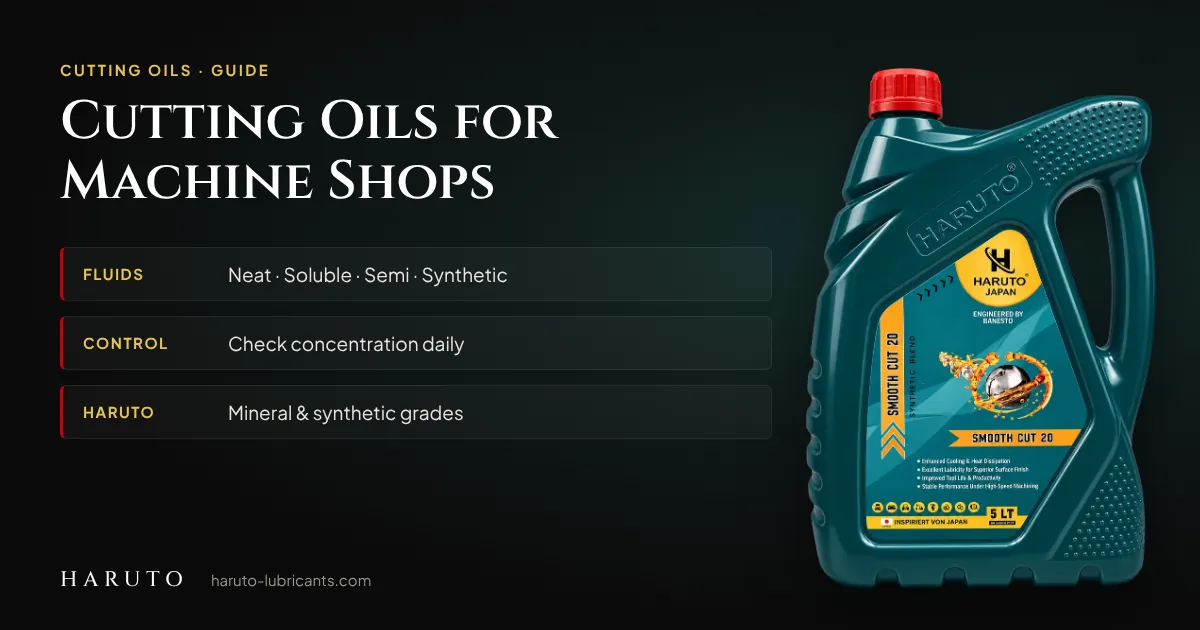
This guide explains what metalworking fluids do, how neat, soluble, semi-synthetic and synthetic fluids differ, how to match them to operations and materials, and how to keep a sump healthy through an Indian summer and monsoon — then what to ask a supplier, and where the Haruto Cutting Oil Series fits.
What Cutting Oil Actually Does
When a tool shears metal, almost all the energy that goes into the cut turns into heat at the tool tip, in the chip and in the workpiece. The fluid is there to manage that heat and the friction that creates it. It does six jobs at once:
- Cooling — carries heat away from the edge and the part. A hot part measured at the machine shrinks as it cools and can go out of tolerance.
- Lubrication — reduces friction between chip and tool, cutting built-up edge and cutting force.
- Chip flushing — clears chips from the cut, drill flutes and tapped holes so they are not recut.
- Corrosion protection — protects the part, table and slideways between operations.
- Surface finish — less friction means cleaner surfaces and fewer rejections.
- Tool life — steady temperature and lubrication slow wear on inserts, drills and taps.
The Four Families of Cutting Fluid
Metalworking fluids are grouped by how much mineral oil they contain and whether they are mixed with water before use. ISO 6743-7 is the classification standard for this family of lubricants, but in the shop four names cover almost everything.
Neat (straight) cutting oils
Used as supplied, never mixed with water. The base is usually mineral oil, often fortified with fatty oils and extreme-pressure (EP) additives based on sulphur or chlorine compounds. Neat oils give the best lubrication and natural rust protection, but they remove heat poorly, smoke and mist at high speeds, carry a fire risk when the cut runs hot, and drag out on chips and parts.
Soluble (emulsifiable) oils
A mostly mineral-oil concentrate with emulsifiers, corrosion inhibitors and often EP additives. Mixed with water it forms a milky emulsion: the water cools, the oil droplets lubricate. It is the workhorse of Indian machine shops. Limits: you cannot see the part through it, it is more prone to bacterial growth than synthetics, and it is sensitive to hard water and tramp oil.
Semi-synthetic fluids
Less mineral oil, more water-soluble chemistry, mixing to a translucent fluid with much finer droplets. Compared with soluble oil they cool better, run cleaner and usually last longer in the sump, while keeping reasonable lubricity. Limits: they can foam in soft water or with high-pressure through-spindle coolant, and irritate skin more if run too rich.
Fully synthetic fluids
No mineral oil at all; they mix to a clear, often dyed solution. They give the best cooling, the cleanest machines and a clear view of the work, and they reject tramp oil well. Limits: lower lubricity for heavy cuts, sticky residue if left to dry, and a tendency to strip the oil film off slideways.
| Family | Mixed with water? | Cooling | Lubricity | Typical operations |
|---|---|---|---|---|
| Neat oil | No | Low | Highest | Tapping, broaching, gear cutting, deep-hole drilling |
| Soluble oil | Yes — milky emulsion | Good | Good | General turning, milling, drilling |
| Semi-synthetic | Yes — translucent | Very good | Moderate to good | CNC turning and machining centres |
| Fully synthetic | Yes — clear | Highest | Lower | Grinding, light high-speed cuts |
Mineral vs Synthetic in Plain Terms
“Mineral” means the base is refined from crude oil. “Synthetic” is used two ways in this trade. In water-mix fluids it means no mineral oil at all. In neat oils and blends it can mean a man-made base fluid, such as an ester, used alone or blended with mineral oil to improve lubricity or oxidation life. A “synthetic blend” combines the two — the data sheet tells you what it is and how to use it.
Mineral-based fluids are forgiving and lubricate strongly; synthetic chemistry generally brings cleaner running, better cooling or longer life. Neither is automatically better — the operation decides, as with mineral vs synthetic engine oil.
Matching the Fluid to the Operation
A simple rule: the harder the tool has to push the chip, and the less room the fluid has to reach the cut, the more lubrication matters. The faster the cut and the tighter the tolerance, the more cooling matters.
| Operation | What it demands | Typical fluid choice |
|---|---|---|
| Turning | Cooling at speed, chip control | Soluble or semi-synthetic; neat oil on sliding-head autos |
| Milling | Cooling for interrupted cuts, flushing pockets | Soluble or semi-synthetic at high flow |
| Drilling | Clearing chips from the hole, cooling the point | Water-mix for general work; neat or richer mix for deep holes |
| Tapping and threading | Maximum lubricity at low speed | Neat oil or a richer water-mix |
| Grinding | Heat removal, clean wheel, settling fine swarf | Synthetic or lean semi-synthetic; neat oil for some thread and gear grinding |
| Broaching | Very high cutting pressure, finish over a long tool | Neat oil with EP additives |
Matching the Fluid to the Material
This is general industry guidance; the fluid’s data sheet has the final word on which metals it suits.
- Steel — soluble or semi-synthetic for general work; EP-fortified neat oil or a richer mix for tough grades, tapping and broaching. Stainless steel work-hardens and needs good lubricity.
- Cast iron — produces powdery chips, and graphite in grey iron gives some self-lubrication. Many shops cut it dry or with a lean water-mix; wet fines rust quickly and clog filters, so corrosion inhibition and filtration matter most.
- Aluminium — soft and sticky, prone to built-up edge. It needs good lubricity and a fluid formulated not to stain, because strongly alkaline fluids can discolour or etch aluminium alloys.
- Brass and copper alloys — free-machining brass cuts easily; the main risk is staining. Neat oils with active sulphur can discolour yellow metals, so choose a fluid stated as non-staining.
Concentration Control for Water-Mix Fluids
Most water-mix fluid problems start with the wrong concentration. Water evaporates every shift, so the mix drifts richer; operators then top up with plain water or guess the concentrate by eye, and it swings lean. Measure, do not guess.
Using a refractometer
- Take a sample from the flowing coolant at the nozzle, not from the surface of the sump.
- Place two or three drops on the prism, close the cover and read the Brix scale against the light.
- Multiply the reading by the refractometer factor on the product data sheet. The answer is the concentration in per cent.
- Record it against the machine and the date.
Tramp oil in the sample blurs the line and pushes the reading up, so skim before measuring. pH strips are a useful second check: water-mix fluids typically run mildly alkaline, around pH 8.5 to 9.5, and a falling pH usually signals bacterial growth.
| Condition | What you see |
|---|---|
| Too lean | Rust on parts and machine tables, shorter tool life, poorer finish, faster bacterial growth |
| Too rich | Wasted concentrate, foaming, sticky residue, skin irritation, more drag-out on parts |
Working concentrations are typically lean for grinding, moderate for general machining and richer for heavy cuts and tapping. The supplier’s data sheet gives the actual range for each operation.
Sump Management in Indian Conditions
Water quality
Hard borewell water, common across Gujarat and Rajasthan, carries calcium and magnesium salts that split emulsions and leave greasy scum. Very soft or RO water can make some fluids foam. Evaporation leaves salts behind, so topping up with hard water keeps raising the mineral load. Ask what water hardness the fluid is designed for, and top up with premix.
Tramp oil
Hydraulic, slideway and spindle oil leaking into the sump is called tramp oil. It floats, cuts off air, feeds bacteria, adds smoke and distorts concentration readings. Skim it daily and fix the leaks at source — a well-maintained hydraulic unit, as covered in our hydraulic oil guide, leaks far less into your coolant.
Bacteria and the rotten-egg smell
When a machine stands idle over a weekend or a Diwali break, oxygen in the sump runs out and bacteria that live without air release hydrogen sulphide — the Monday-morning rotten-egg smell. Other signs: falling pH, dark fluid, slime and a sudden rise in rust. Hold concentration in range, skim tramp oil, circulate before and after long stops, and keep rags, tea and food out of the sump. A badly infected sump needs draining, cleaning and recharging — topping it up only spreads the problem.
Foaming and rust
Foam usually comes from a rich mix, soft water, high-pressure pumps or a low sump level that draws air. Rust usually means a lean mix, chloride-rich water or parts stacked wet. Check concentration and level first.
Summer heat and monsoon
In May and June, sumps under tin roofs run warm, water evaporates fast and bacteria multiply faster, so check concentration more often. In the monsoon, humidity can rust machined parts overnight — protect parts waiting between operations — and rainwater from roof leaks dilutes and contaminates open sumps.
Operator Health and Safety
- Skin — repeated contact can cause dermatitis. Use nitrile gloves for handling and cleaning, but never near rotating spindles or chucks, where a glove can be caught. Use barrier cream, wash with mild soap, and never clean hands with kerosene or solvent.
- Mist — keep guards closed, fit mist collectors where possible and ventilate the shop.
- Eyes and clothing — wear safety glasses, change oil-soaked clothes and never carry oily rags in pockets.
- Concentrate and fire — handle undiluted concentrate with gloves and goggles; hot cuts with neat oil can ignite mist, so keep suitable extinguishers nearby.
The safety data sheet lists each product’s hazards, protective equipment and first aid. Keep it where operators can read it.
Disposing of Used Fluid Responsibly
Spent cutting fluid and used neat oil must never go down a drain, into the soil or into a nala. Send used oil to a recycler authorised by your State Pollution Control Board; spent emulsions are usually split into oil and water phases by an authorised waste handler. Keep records of what you send. Good sump control means fewer drains in the first place.
Daily and Weekly Sump Check
| When | Check | Action if out of range |
|---|---|---|
| Daily | Sump level | Top up with premix at the correct concentration, not plain water |
| Daily | Concentration by refractometer | Adjust with water or concentrate to the data-sheet range |
| Daily | Smell and appearance | Investigate a sour smell, dark colour or cream on the surface |
| Daily | Tramp oil layer | Skim, then trace the leak |
| Weekly | pH | A falling pH suggests bacteria; consult the supplier |
| Weekly | Chips and fines | Clean out swarf, check screens and filters |
| Weekly | Rust on table or a test chip | Raise concentration, check water quality |
| Weekly | Foam | Check concentration, level and water source |
| Every drain | Whole system | Clean with system cleaner, rinse, recharge fresh |
Buying and Storage
- Keep drums sealed until use and closed between draws; open containers pick up dust, water and bacteria.
- Out of sun and rain. A drum baking in the sun breathes in moist air as it cools at night. Store indoors; if drums must stand outside, lay them on their side with the bungs at three and nine o’clock.
- Follow the storage temperature on the data sheet — some concentrates separate if overheated.
- First in, first out. Mark the receipt date on every pack and use the oldest first.
- Clean dispensing. Use dedicated, labelled cans and pumps, never old engine-oil containers.
How to Evaluate a Cutting Oil Supplier
Ask any supplier for the following before you commit:
- Product data sheet — the fluid type, recommended concentrations for each operation, the refractometer factor, the materials it suits and the water hardness it tolerates.
- Safety data sheet — hazards, protective equipment, first aid, storage and disposal guidance.
- A trial — run it on one or two machines for several weeks and record tool life, finish, smell, rust and operator comfort against your current fluid.
- Support and consistency — help with sump testing and troubleshooting, the same product every batch, and reliable delivery.
The Haruto Cutting Oil Series
The Haruto Cutting Oil Series is offered in mineral and synthetic grades, so the choice can follow the work. Haruto Smooth Cut 20 is a cutting oil from the series, supplied in a 5 L pack and labelled “Synthetic Blend”. Its label states that it is designed for:
- Enhanced Cooling & Heat Dissipation
- Excellent Lubricity for Superior Surface Finish
- Improved Tool Life & Productivity
- Stable Performance Under High-Speed Machining
These describe what the product is designed to do. The way to confirm the fit for your shop is the process above: read the data sheet, then trial it on your own machines. Tell us your machines, materials and operations — a CNC turning centre on steel shafts, a machining centre on aluminium housings or a bank of tapping machines — and we will recommend the right grade from the series. You can also browse the full Haruto product range.