Compressor Oil Guide: VDL Grades, 68 vs 100 and Mineral vs Synthetic
Most air compressors in Indian plants and workshops are bought on capacity and cost, then filled with whatever oil is on the shelf. The oil gets attention only when the separator starts passing oil into the air lines, the unit trips on high temperature, or a valve comes out caked in black carbon. By then the damage is done.
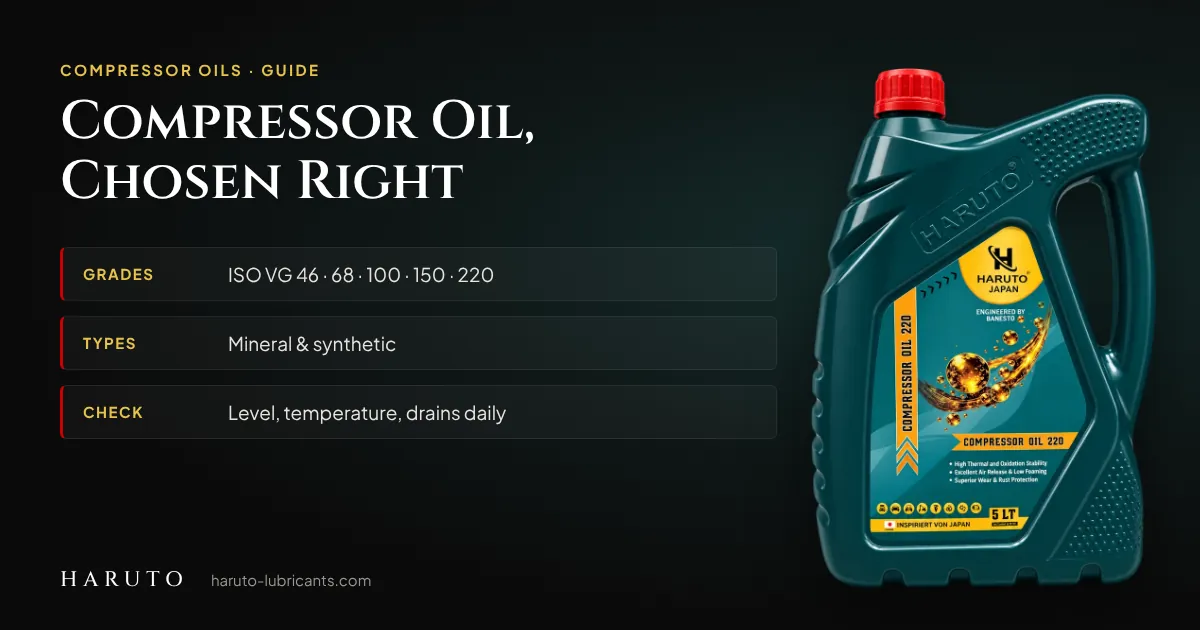
This guide covers what compressor oil does, how piston, screw and vane machines treat it differently, what VDL means, how to choose between ISO VG 46, 68, 100, 150 and 220, when synthetic is worth paying for, and what to check every day — with Indian heat, dust and monsoon humidity in mind.
What compressor oil actually does
Compressing air makes heat, and the oil works in that heat in contact with hot, oxygen-rich air. Few lubricants face a harsher environment. Compressor oil does three jobs:
- Lubricate. It keeps a film on bearings, crankshafts, piston rings, screw rotors or vanes.
- Seal. In screw and vane compressors the oil fills the fine clearances between rotors, vanes and casing so air cannot slip back to suction. Thin or degraded oil means less air for the same power.
- Cool. In an oil-injected screw compressor, oil is sprayed into the compression chamber in volume and carries most of the heat of compression to the oil cooler. Here the oil is the cooling system.
It must also protect against rust, separate cleanly from water, release air quickly, resist foaming — and above all, not break down into carbon and varnish on hot metal.
Reciprocating vs rotary-screw vs vane: how oil demands differ
| Compressor type | How the oil is used | Main stress | What matters most |
|---|---|---|---|
| Reciprocating (piston) | Crankcase oil; a thin film reaches cylinder walls and discharge valves | Highest discharge temperatures, thin films on hot valves | Low carbon formation, oxidation stability |
| Rotary screw (oil-injected) | Injected into the compression chamber, separated, cooled, filtered and reinjected | Constant churning with hot air for thousands of hours | Oxidation life, air release, water separation, low foaming |
| Rotary vane (oil-flooded) | Injected to seal vane tips and cool; separated like a screw | Vane-tip rubbing plus heat | Film strength, oxidation stability, cleanliness |
In a piston compressor, the crankcase runs at modest temperatures, but oil that climbs past the rings meets discharge valves and pipes that can run very hot, especially in single-stage units pushed to high pressure. That is where carbon forms. A workshop compressor running long hours in a hot tin shed is the classic case.
In a screw compressor, discharge temperatures are typically lower because the oil absorbs the heat, but the oil never rests: one charge may circulate for thousands of hours. Oxidation life and clean air and water release decide how long it lasts. Vane compressors add vanes rubbing on the stator, so film strength and cleanliness matter — varnish can make vanes stick in their slots.
VDL compressor oil explained: DIN 51506 in plain terms
DIN 51506 is the German standard most Indian buyers meet as letters on a compressor oil label. It groups air-compressor oils by how hot the discharge may run:
- VB / VBL — discharge temperatures up to about 140 °C.
- VC / VCL — up to about 160 °C.
- VDL — the highest tier, up to about 220 °C, and the class normally asked for in both piston and oil-injected rotary air compressors.
The “L” means the oil carries additives, typically oxidation and corrosion inhibitors. The defining VDL test is about carbon: the oil is aged by heating it while air is blown through it over an iron oxide catalyst, and the carbon residue left behind is measured. VDL sets the strictest limits.
Why carbon is the enemy: degraded oil bakes onto valves, seats and discharge pipes — first as sticky varnish, then hard carbon. Valves stop seating, the compressor recompresses hot air, runs hotter and delivers less. In the worst case, oil-soaked deposits in discharge lines can overheat and ignite — which is why manuals insist on a low-carbon-forming oil and periodic line cleaning.
Some manuals quote ISO 6743-3 instead, which uses codes such as DAA and DAB for piston compressors and DAG, DAH and DAJ for oil-flooded rotary units. Whichever system the manual uses, match it.
Choosing the grade: ISO VG 46, 68, 100, 150 or 220
The ISO VG number is nominal viscosity in centistokes at 40 °C — ISO VG 68 spans 61.2–74.8 cSt, ISO VG 100 spans 90–110 cSt. The compressor manual comes first. Where it offers a choice by ambient temperature, Indian summers usually push you to the upper end.
| Compressor and duty | Conditions | Grade typically used |
|---|---|---|
| Oil-injected screw, standard duty | Ventilated room, up to about 35 °C | ISO VG 46 |
| Oil-injected screw, hot room or higher pressure | Above about 35 °C, poor ventilation | ISO VG 68, if the manual allows |
| Rotary vane, oil-flooded | As stated by the maker | ISO VG 46 to 100 |
| Small piston unit, light or intermittent duty | Moderate ambient | ISO VG 68 |
| Piston unit, general workshop and plant duty | Hot Indian ambient | ISO VG 100 |
| Piston unit, heavy duty, high pressure or long hours | Hot ambient, sustained load | ISO VG 150 |
| Large, slow, heavily loaded piston machines | Only where the manual specifies it | ISO VG 220 |
Two common mistakes. Going thicker “for protection” in a screw compressor slows air and water release, raises power draw and can upset the separator. Going thinner in a hot piston compressor because the old oil “looked thick” weakens the cylinder film and raises oil consumption. If a machine runs hotter than its grade can handle, fix the cooling first.
Mineral vs synthetic compressor oil
Synthetic compressor oils — commonly based on PAO, esters or polyalkylene glycols — resist oxidation far better than mineral oil and leave much less residue as they age. That means longer oil life and cleaner valves and separators. The extra cost earns its place where you have:
- High discharge temperature — high pressure, hot compressor rooms or heavy load.
- Long running hours — screw compressors on two or three shifts, where every oil change means a shutdown.
- Longer drain intervals — where the manual approves an extended interval, fewer changes and less waste oil can outweigh the higher cost per litre.
- Repeated varnish — machines that keep varnishing valves or separators on mineral oil after the cooling has been checked.
Mineral VDL oil is perfectly adequate for intermittent workshop piston compressors, single-shift screw units in ventilated rooms, and any machine whose mineral-oil interval suits the user. A good mineral oil changed on time beats a synthetic left in too long. Our mineral vs synthetic engine oil guide explains the base-oil differences. One caution: some synthetic chemistries do not mix with mineral oil, so a switch means drain and flush, not top-up.
Why engine oil and hydraulic oil do not belong in a compressor
- Engine oil carries heavy detergent and dispersant additives built to hold soot in suspension. In a compressor, metal-containing additives can leave ash on hot valves, and dispersants tend to hold water in the oil instead of letting it separate, encouraging emulsions and rust. Engine oils are also not formulated for the quick air release a screw separator depends on.
- Hydraulic oil is built for pump wear protection at moderate temperatures, not for the carbon-forming limits of VDL oils at discharge temperatures; in a hot piston unit it can varnish valves quickly. A matching ISO VG does not make it the same oil — our hydraulic oil selection guide explains what hydraulic oils are designed for.
The saving from a spare drum is tiny next to the cost of a separator, valves or an airend.
Signs of compressor oil trouble
| Symptom | Likely causes | What to check |
|---|---|---|
| Oil carry-over into air lines and tools | Overfilled sump, damaged separator, blocked scavenge line, foaming oil, running below minimum pressure | Oil level, separator pressure drop, scavenge line, oil type |
| High discharge temperature or trips | Dust-choked cooler, low oil, stuck thermostatic valve, blocked filter, degraded or wrong-grade oil, hot room | Cooler, level, thermostat, filter, ventilation |
| Varnish or carbon on valves and discharge pipes | Oil past its life, non-VDL oil, sustained high temperature | Oil class and age, discharge temperature |
| Foam in the sight glass | Another oil mixed in, overfilling, water | Recent top-ups, level, oil condition |
| Milky or emulsified oil | Condensate: unit running too cool, short cycling, failed drains | Operating temperature, run pattern, drains |
Act on the first sign, not the trip.
Condensate and the Indian monsoon
On a humid monsoon day in Mumbai or coastal Gujarat, intake air carries a great deal of moisture, and compression concentrates it. Most condenses in the aftercooler, receiver and lines — but some reaches the oil.
In a screw compressor the key is temperature. The unit must run hot enough that water stays as vapour and leaves with the air. A machine that is oversized, starts and stops frequently or idles unloaded for long spells may never get there, and water collects in the oil: milky oil, rust, poor lubrication and shorter separator life. The thermostatic valve exists for exactly this reason — never remove it or wedge it open to “keep the unit cool”.
- Drain the receiver and line drop legs daily, and confirm automatic drains actually discharge.
- Check the sight glass daily; any cloudiness is a warning.
- Avoid long spells of light load on a large screw unit; review sizing or controls if demand has dropped.
- Store drums under cover so rainwater cannot collect on the lid and be drawn in.
Oil changes, separators and filters
The compressor manual decides the interval, the oil type and the parts to change, and warranty depends on following it. As rough orientation only: screw compressors on mineral oil are commonly changed in the low thousands of running hours; synthetic typically lasts considerably longer where the maker approves; piston crankcases commonly run a few hundred to around a thousand hours, or on a calendar basis for lightly used units. Shorten it in heat, heavy dust or humidity, or after water ingress; on critical installations, oil analysis lets you change on condition.
In a screw compressor, change the oil filter with every oil change unless the manual says otherwise. The air–oil separator element is usually replaced on hours or when its pressure drop reaches the manual’s limit; a ruptured element sends oil downstream. The intake filter needs more attention in Indian dust than most manuals assume — dust that gets past it becomes an abrasive in the oil.
Topping up and mixing compressor oils
Top up with the same oil — type, grade and preferably brand — already in the machine, and keep a labelled container beside the compressor so nobody grabs the nearest drum. Add oil with the unit stopped and depressurised, up to the sight-glass mark and never above it; overfilling is one of the commonest causes of carry-over.
Mixing different compressor oils risks foaming, deposits and additive clashes. Mineral with synthetic, or one synthetic chemistry with another, can be incompatible. When changing type or supplier, drain completely, change the filter and follow the maker’s flushing procedure. Frequent top-ups point to carry-over, leaks or worn rings — find the cause.
Daily and weekly compressor checks
| When | Check | Why it matters |
|---|---|---|
| Daily | Oil level in the sight glass | Low oil overheats; high oil carries over |
| Daily | Oil appearance — clear, not milky or foaming | Early warning of water or contamination |
| Daily | Discharge temperature reading | A rising trend means cooling or oil trouble |
| Daily | Drain receiver and drop legs; check auto drains | Removes condensate, critical in the monsoon |
| Weekly | Cooler fins and ventilation openings | Dust-choked coolers drive up temperature |
| Weekly | Intake filter condition | Keeps abrasive dust out of the oil |
| Weekly | Separator pressure drop, where a gauge is fitted | Separator condition and carry-over risk |
| Weekly | Oil at drains and points of use | Carry-over shows up here first |
| Weekly | Running hours against the next service | Keeps oil, filter and separator changes on time |
How the Haruto compressor oil series maps to these needs
The Haruto compressor oil range is made for rotary-screw and reciprocating air compressors, industrial compressed-air systems and workshop and plant air supply. It is designed for low carbon and varnish formation, high oxidation and thermal stability, and good water separation and anti-corrosion — the properties this guide keeps returning to.
| Grade | ISO VG | Typical application |
|---|---|---|
| Compressor Oil 46 | ISO VG 46 | Rotary and reciprocating compressors, moderate duty |
| Compressor Oil 68 | ISO VG 68 | General-purpose air compressors |
| Compressor Oil 100 | ISO VG 100 | High-temperature / high-pressure duty |
| Compressor Oil 150 | ISO VG 150 | Heavy-duty reciprocating compressors |
| Compressor Oil 220 | ISO VG 220 | Also supplied — confirm the fit against your manual |
The series comes in mineral and synthetic formulations, so the choice above can be made within one range. Haruto Compressor Oil 220 is sold in 1 L and 5 L packs, and its label carries three claims: “High Thermal and Oxidation Stability”, “Excellent Air Release & Low Foaming” and “Superior Wear & Rust Protection”. The product page lists 5 L, 20 L, 50 L and 210 L packs, with other sizes on request — a drum for oil changes, a small pack beside the machine for topping up.
To choose, send us the compressor type, make and model, working pressure, daily running hours, room conditions and the grade the manual calls for. We will confirm the grade and formulation; the manual still has the final say. Grade details and data sheet requests are on the compressor oil product page.